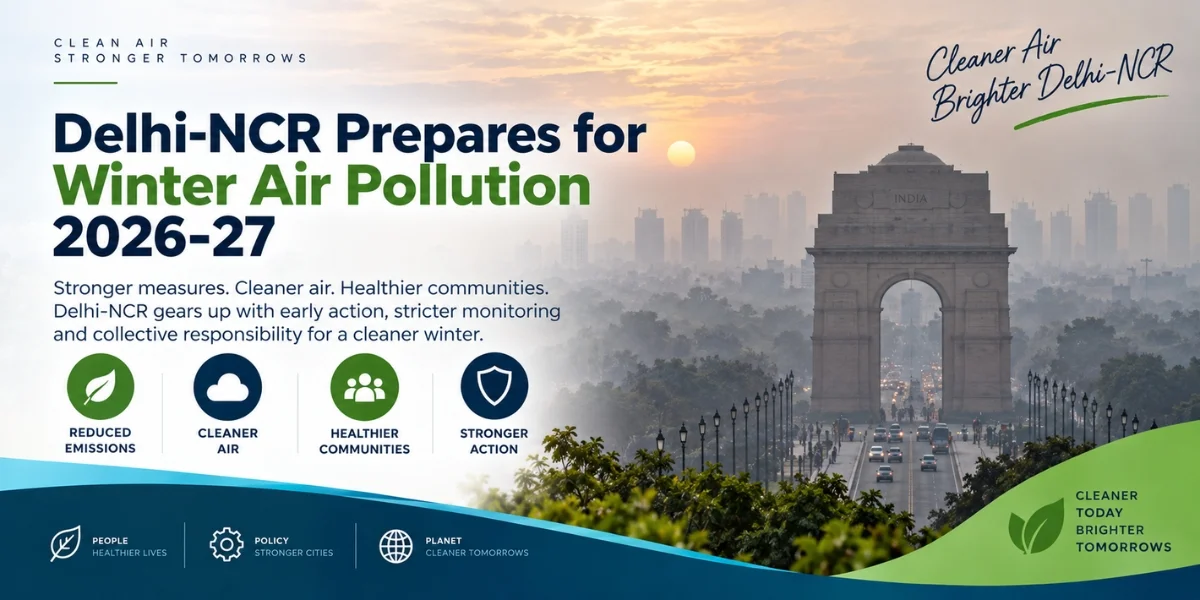
Union Environment Minister Bhupender Yadav and Delhi Environment Minister Manjinder Singh Sirsa chaired two review meetings on September 3, 2026, to finalise a coordinated action plan for controlling air pollution across Delhi-NCR through the winter season, covering the period from September 2026 to March 2027. The meetings, attended by environment ministers and senior officials from Delhi, Haryana, Punjab, Rajasthan and Uttar Pradesh, mark the formal start of this year's winter preparedness cycle in the capital region.
Why Delhi-NCR Sees Worse Air Quality in Winter
Delhi-NCR's air quality typically deteriorates from late October through January due to a combination of factors specific to the season. Lower wind speeds and cooler temperatures trap pollutants closer to the ground, a phenomenon commonly referred to as an inversion layer, which prevents smoke, dust and vehicular emissions from dispersing as they would in warmer months. This seasonal effect combines with existing sources such as vehicular traffic, construction activity, industrial emissions and, in late autumn, crop residue burning in neighbouring states, to push air quality into the poor to severe range for extended periods.
What Authorities Are Preparing for Winter 2026-27
According to officials, Delhi will deploy 78 sub-divisional teams and 256 ward-level teams this winter, tasked with acting against biomass burning, construction and demolition dust, industrial emissions, use of unauthorised fuels, and illegal dumping of construction waste or garbage. These teams will also monitor construction and demolition projects through the government's Dust Portal and check compliance with CAQM Direction No. 76, which governs the use of diesel generator sets.
Enforcement teams have additionally been assigned to inspect the Municipal Corporation of Delhi's decentralised construction and demolition waste secondary storage centres, identify unpaved roads and roads with significant potholes that contribute to dust, and ensure timely redressal of public complaints filed through the Green Delhi App and the 311 App. Officials described the approach as combining stricter enforcement, pollution-source identification and targeted action in known pollution hotspots across the region.
The Role of the Graded Response Action Plan (GRAP)
GRAP is the Commission for Air Quality Management's (CAQM) framework of emergency measures that scale up automatically as Delhi's Air Quality Index (AQI) worsens. The plan currently operates in four stages: Stage I for "Poor" air quality (AQI 201-300), Stage II for "Very Poor" (AQI 301-400), Stage III for "Severe" (AQI 401-450), and Stage IV for AQI above 450. Each stage adds further restrictions on top of the ones already in force under earlier stages, and CAQM's Sub-Committee on GRAP reviews air quality data and forecasts from the India Meteorological Department and the Indian Institute of Tropical Meteorology before deciding whether to invoke or revoke a stage. During winter 2025-26, for example, Stage III restrictions were invoked in mid-January 2026 as Delhi's AQI approached the "Severe" category, illustrating how quickly restrictions can tighten once conditions deteriorate.
Measures Targeting Major Pollution Sources
The winter plan addresses several major contributors to poor air quality in a coordinated way rather than treating them in isolation.
- Construction and demolition dust: Sites are required to register on the Dust Portal and follow dust-control norms, with restrictions tightening further once higher GRAP stages are invoked.
- Vehicular emissions: CAQM has indicated it will constitute an expert committee specifically focused on vehicular pollution, which is considered a major contributor to wintertime PM2.5 levels in the region.
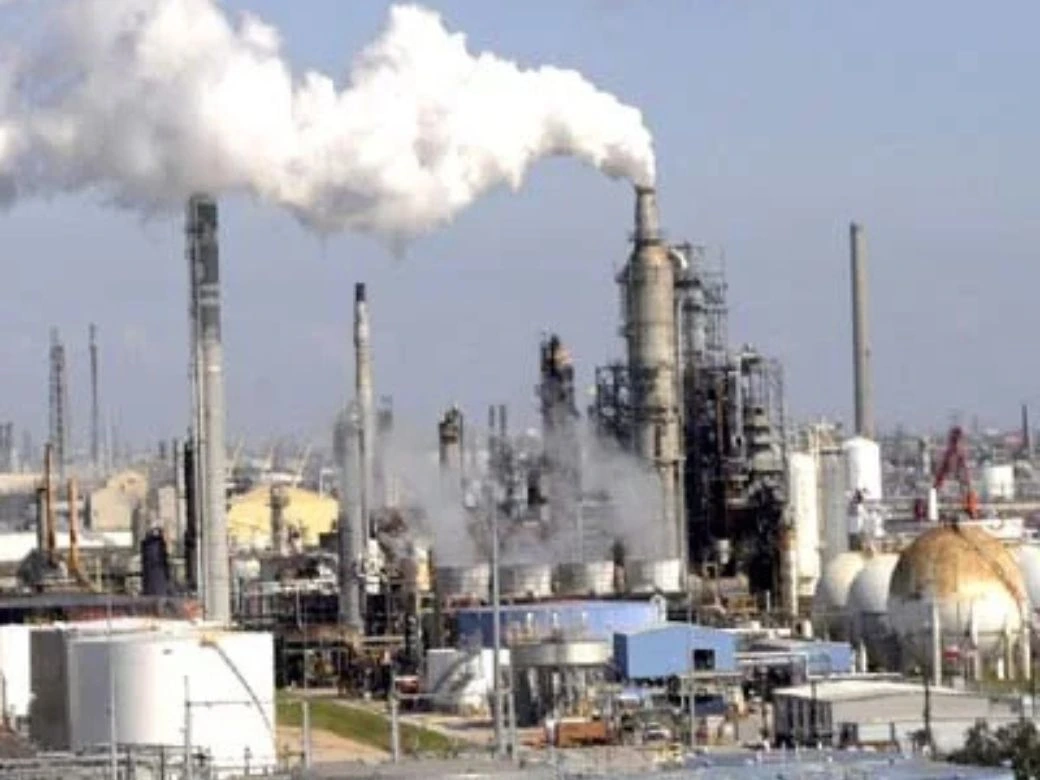
- Industrial emissions: Industries in specified categories are required to install Online Continuous Emission Monitoring Systems (OCEMS) and appropriate Air Pollution Control Devices, with these systems linked directly to CPCB servers to flag units exceeding permitted emission limits.
- Open burning and unauthorised fuels: Enforcement teams are tasked with acting against biomass burning and the use of unauthorised fuels, alongside checks on diesel generator set usage under CAQM Direction No. 76.
As of the most recent publicly reported update from the Central Pollution Control Board, over 1,200 of roughly 2,250 industrial units required to install OCEMS under this drive had completed installation, with authorities indicating that non-compliant units could face closure. This figure reflects the state of enforcement reported in late 2025 and is expected to be updated as the current winter's compliance drive progresses.
Public-Health and Environmental Implications
Sustained periods of poor air quality during winter are associated with reduced visibility, discomfort for outdoor workers and commuters, and general strain on regional air quality management systems. Authorities have accordingly focused on early, coordinated action, including regional cooperation with neighbouring states, rather than measures limited to Delhi alone, given that pollution sources and dispersion patterns cross state boundaries. This article does not make specific medical claims about health outcomes; readers seeking health guidance during periods of poor air quality should refer to advisories from public health authorities.
What This Means for Industries
For industrial units operating in and around Delhi-NCR, the current enforcement drive reinforces the importance of having functional, well-maintained air pollution control equipment in place well before winter restrictions intensify. Units in categories mandated to install OCEMS need these systems properly calibrated and linked to CPCB monitoring servers, since non-compliance has been flagged as grounds for enforcement action, including potential closure.
Beyond regulatory compliance, continuous emission monitoring gives industrial operators real-time visibility into their own performance, allowing corrective action before a unit breaches permitted limits rather than after an inspection flags a violation. As GRAP stages escalate during periods of poor air quality, industries with verified, compliant pollution-control systems are better positioned to continue operations within permitted limits, rather than facing the blanket restrictions that can apply to non-compliant or unmonitored units.
Key Highlights
- Union and Delhi environment ministers finalised a winter action plan on September 3, 2026, covering September 2026 to March 2027.
- Delhi will deploy 78 sub-divisional and 256 ward-level enforcement teams targeting dust, biomass burning and illegal dumping.
- GRAP remains the core framework, with four AQI-linked stages ranging from "Poor" to severe conditions above AQI 450.
- CAQM plans to set up an expert committee focused specifically on vehicular pollution.
- Industries in mandated categories continue to be required to install and maintain OCEMS and pollution-control devices, with enforcement action possible for non-compliance.
Conclusion
Delhi-NCR's winter air pollution challenge is shaped by seasonal weather patterns combined with a wide mix of pollution sources spread across several states, which is why this year's preparation has again emphasised coordination between Delhi and neighbouring governments alongside ward-level enforcement and industrial monitoring. Whether these measures translate into measurably better air quality will depend on how consistently they are implemented as winter conditions set in, but the early, structured preparation reflected in this year's plan is a necessary starting point for managing the season ahead.
Sources & Further Reading
This article draws on official government reporting and news coverage, including the The Statesman, Daily Prabhat (citing the Ministry of Environment, Forest and Climate Change press release), and the Tribune India report on industrial OCEMS compliance. Background on GRAP's structure is drawn from official CAQM press releases available at caqm.nic.in.