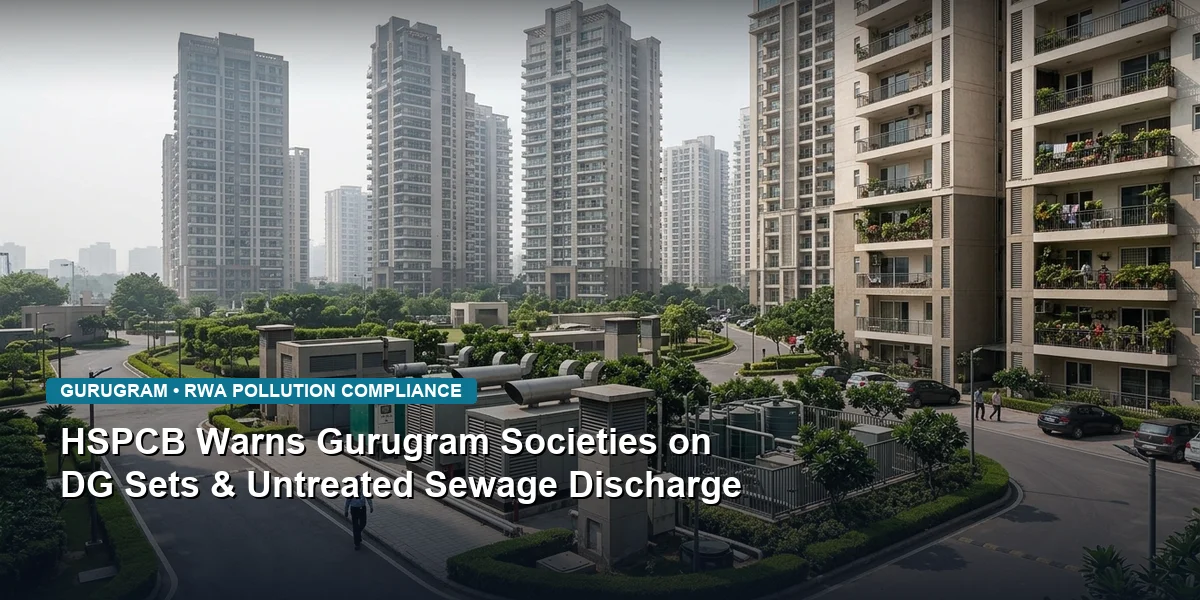
The Haryana State Pollution Control Board (HSPCB) has put Gurugram's residential societies on notice. At an awareness and compliance meeting held on Wednesday, October 14, 2026, the board cautioned resident welfare associations (RWAs) and facility managers against two everyday practices: running non-compliant diesel generator sets for routine power supply, and discharging untreated sewage into public drains.
The warning lands as the Delhi-NCR winter pollution season begins, when air-quality rules tighten and wastewater violations draw closer scrutiny.
What the Board Told Residential Societies
The meeting brought together RWA representatives and facility managers. The board called for strict compliance with air pollution control measures and wastewater treatment standards, and pointed to the rules that apply:
- CAQM Direction No. 76, which governs diesel generator sets in the NCR
- The Graded Response Action Plan (GRAP), which restricts polluting activity as air quality worsens
- Sewage treatment plant (STP) regulations, which set discharge standards for treated wastewater
Assistant Executive Engineer Kamesh was named in the report as speaking on diesel generators at the session. The published excerpt does not carry deadlines or penalty figures, so none are stated here.
Why Diesel Gensets Are Under the Spotlight
Large housing societies often run backup generators for lifts, water pumps and common areas during power cuts. Under CAQM's rules, gensets in the NCR must be fitted with retrofitted emission control devices (RECDs) or converted to PNG-based dual-fuel kits. CAQM has enforced this before. In February 2024, for example, it ordered sealing of generator sets at 11 industrial units in Palwal district for operating without such retrofits.
What this means for society managers
- Check whether each genset has an RECD or dual-fuel kit installed and documented
- Keep generator use to genuine emergencies, not routine supply
- Maintain service and emission records, since inspectors ask for them
- Expect stricter checks once GRAP stages are invoked
Untreated Sewage: The Second Warning
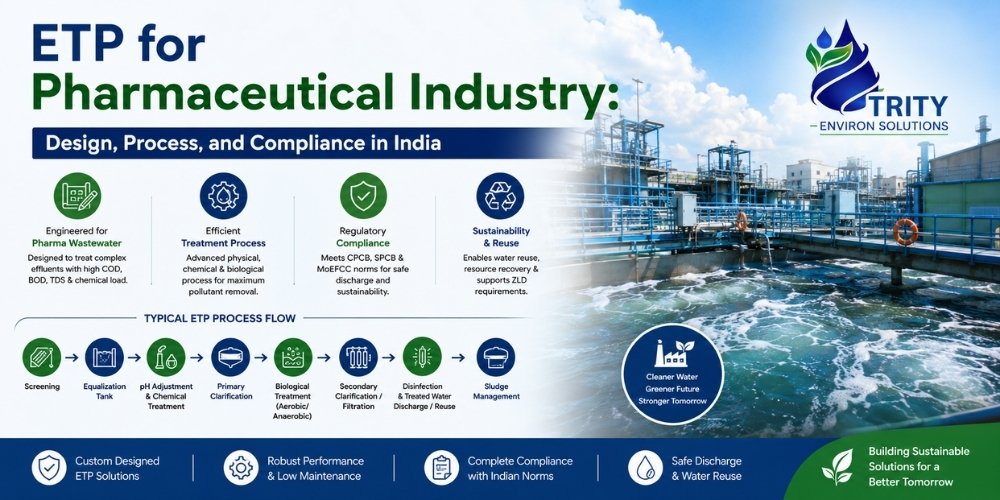
The second part of the advisory is about sewage. Many large societies are required to operate their own sewage treatment plants and release only treated water. Problems start when a plant is undersized, poorly maintained, or bypassed.
Common failure points in society STPs
- Aeration blowers or pumps that are down, so biological treatment stops
- Overloaded plants receiving more flow than their design capacity
- Skipped desludging, which lets solids carry over into the outlet
- No disinfection or filtration before discharge
- Treated water not reused for flushing or gardening, so it ends up in drains anyway
A plant that is running but not treating properly is as much of a violation as no plant at all.
The Bigger Gurugram Picture
The advisory sits against a documented infrastructure gap. A Comptroller and Auditor General (CAG) audit report on Haryana, covered by ThePrint on September 3, 2026, examined eight districts including Gurugram. For the GMDA area it recorded:
- About 550 MLD of sewage generated, against 415 MLD of installed treatment capacity
- Roughly 63 MLD left untreated, with plants receiving about 397 MLD
- 12 of 16 STPs in the district meeting discharge norms
- Drain samples showing BOD of 88 to 106 mg/L, against a limit of 10 mg/L
The audit also found HSPCB inspections fell well short of schedule, and the board attributed this to staff shortages. GMDA has said treatment capacity will reach 977 MLD by December 2028. Until then, every society that treats its own wastewater properly reduces the load on that shared network.
What Societies Can Do Now
For air compliance
- Audit all generator sets and retrofit or replace non-compliant units
- Schedule backup power so gensets are the last option
- Keep emission compliance paperwork ready for inspection
For wastewater compliance
- Test STP outlet water regularly for BOD, COD, TSS and faecal coliform
- Fix blowers, pumps and diffusers before the problem becomes a violation
- Get a proper sewage treatment plant assessment if the plant is old or overloaded
- Put the plant under a structured operation and maintenance contract so daily checks, desludging and servicing do not slip
- Reuse treated water for flushing and landscaping to cut discharge
Looking Ahead
With winter restrictions approaching, enforcement is likely to be more visible. Societies that sort out their generators and STPs now avoid last-minute shutdowns and compensation notices later.