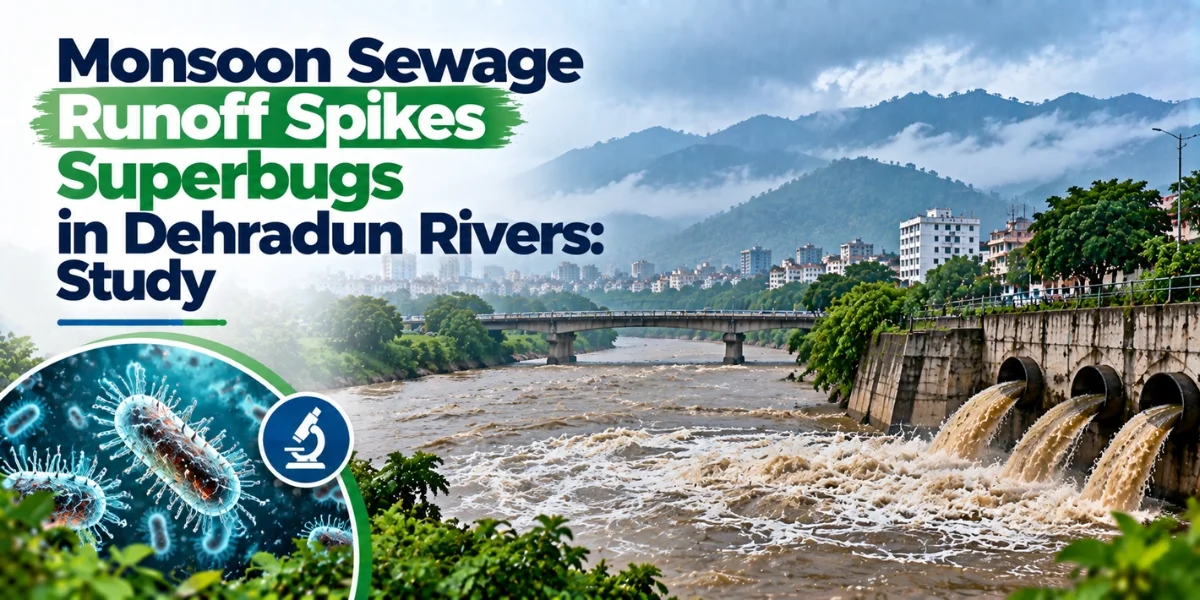
Every monsoon, Dehradun's Bindal and Rispana rivers get a flush of rain, and according to a new IIT Roorkee study, they also get a flush of superbugs. Researchers found that during the monsoon, the relative abundance of genes that let bacteria resist common antibiotics jumped by up to a thousand times compared to dry summer months, and the culprit is depressingly familiar: untreated human and animal waste getting washed straight into the rivers.
How Rain Turns Into a Resistance Problem
Here's the counterintuitive part: you'd think heavy rain would dilute pollution, but in cities where sewage and solid waste aren't properly managed, it does the opposite. The runoff acts like a pressure hose, flushing fecal matter from overflowing drains, informal settlements and riverbank waste piles directly into the river system, all at once. That flush carries with it a high concentration of antibiotic-resistant bacteria and the resistance genes (ARGs) they carry.
Published in the journal Environmental Pollution in June 2026, the study by Kenyum Bagra and colleagues at IIT Roorkee tracked genes providing resistance to sulfonamides, macrolides and tetracyclines, three antibiotic classes widely used in both human and veterinary medicine. They also monitored E. coli, a standard marker of fecal contamination, and the intI1 gene, a well-established fingerprint of human-driven pollution. E. coli turned up consistently across all seasons in both rivers, which tells you contamination isn't just a monsoon event, monsoon just makes it dramatically worse.
The Part That Should Really Worry You: Sediment Memory
Post-monsoon, ARG levels in the water itself dropped back toward pre-monsoon baselines, which sounds like good news until you look at the riverbed. Resistance genes in the sediment stayed elevated well after the rains stopped, suggesting the mud at the bottom of the Bindal and Rispana is acting as a long-term reservoir, quietly holding onto resistance genes rather than letting them wash away. That's a meaningfully different problem than a seasonal spike; it means the resistance risk doesn't fully reset between monsoons.
Why This Isn't Just an Uttarakhand Story
Dehradun's rivers are tributaries of the Ganga, so what happens here doesn't stay here. This finding also lines up with a growing body of Indian research on the same theme, including a separate 2026 metagenomic study of Yamuna River sediments that identified 139 distinct antibiotic resistance genes across dozens of microbial species, with aminoglycoside, beta-lactam and tetracycline resistance particularly abundant. Different river, same underlying story: wherever untreated sewage reaches a river consistently, antimicrobial resistance tends to follow.
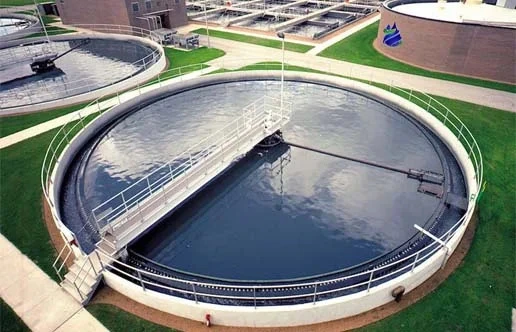
Standard sewage treatment does reduce organic pollution and pathogen counts, but it isn't specifically designed to strip out antibiotic resistance genes, and a plant that isn't hitting its design-level performance closes that gap even less. For river systems already under monsoon stress, consistent, well-maintained treatment capacity is one of the few levers that actually interrupts this cycle at the source, rather than downstream, where the problem is much harder to undo.
Key Highlights
- An IIT Roorkee study found ARG abundance in Dehradun's Bindal and Rispana rivers rose 1 to 3 orders of magnitude, up to roughly 1,000x, during monsoon.
- The surge is driven by untreated sewage and solid waste being flushed into the rivers by heavy rainfall.
- E. coli was consistently detected across all seasons, indicating persistent, not just seasonal, fecal contamination.
- ARG levels in river water declined post-monsoon, but sediment-associated ARGs remained elevated, acting as a long-term reservoir.
- The findings echo similar ARG research on the Yamuna, pointing to untreated sewage as a recurring driver of antimicrobial resistance in Indian rivers.
Sources & Further Reading
This article is based on the peer-reviewed study "Monsoon-triggered surges of antibiotic resistance genes in urban Indian rivers impacted by untreated wastewater" (Environmental Pollution, June 2026) and a plain-language summary published by Research Matters.