TRITY ENVIRO
WATER • WASTEWATER • RECYCLING

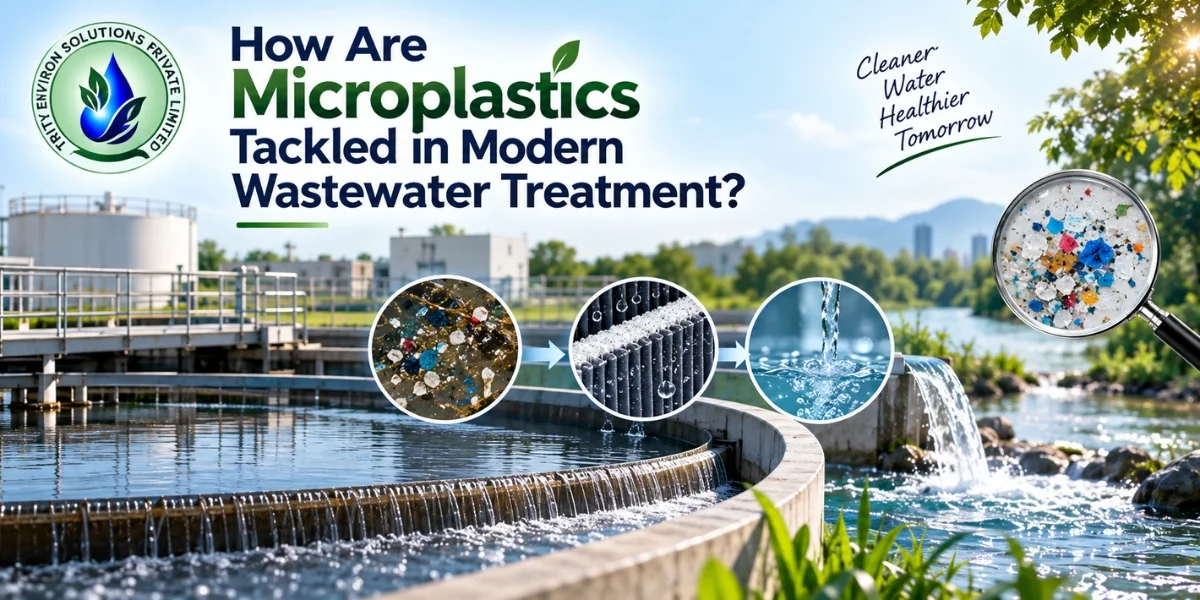
How Are Microplastics Tackled in Modern Wastewater Treatment?

Wastewater treatment plants are one of the main pathways through which microplastics reach rivers, farmland, and eventually the food chain, since particles smaller than 20 microns routinely slip through conventional treatment. This guide covers exactly which technologies actually work, and which gaps remain.
How Are Microplastics Tackled in Modern Wastewater Treatment?

Why Wastewater Treatment Plants Are a Major Microplastic Pathway

Engineering Consultation

Looking to Sizing or Upgrading Your Treatment Plant?

Speak directly with our senior environmental engineers for technical guidance, sizing calculations, or a tailored project proposal.
Call +91-9821030072 or email enquiry@trityenviro.com

Request Free Engineering Consultation
Request a Free Site Assessment
Previous Article Next Article
TECHNICAL QUESTIONS

Frequently Asked Questions

Conventional plants remove a meaningful portion but not all microplastics, since standard treatment was not originally designed to retain particles smaller than about 20 microns. Advanced technologies like membrane filtration can achieve up to 98% removal, but complete elimination remains genuinely difficult with current technology.
Membrane Bioreactor (MBR) technology combined with microfiltration has shown up to 98% removal in documented studies, while a 2026 RMIT University study found enhanced micro-nanobubble dissolved air flotation removed over 90% of microplastics as a primary treatment stage.
Physical separation methods like membrane filtration and dissolved air flotation are non-destructive, meaning they transfer microplastics from the water into the plant's sludge or a concentrated retentate rather than eliminating them, making proper sludge dewatering and disposal an essential part of genuine microplastic management.
Yes, emerging research shows nanocellulose can achieve up to 98% removal through adsorption and filtration, while biopolymers like polysaccharides and lignin can remove up to 99% of particles through clumping and settling, offering biodegradable alternatives to purely synthetic filtration media, though large-scale implementation is still developing.
This depends on the treatment level applied. Standard secondary treatment can leave significant microplastic content in effluent, which is a genuine concern for agricultural reuse. Facilities planning extensive water reuse should incorporate membrane-based tertiary treatment specifically to address this rather than relying on basic treatment alone.
KEEP READING

Related Technical Articles

View All Articles →
PROVEN EXPERIENCE

Featured Turnkey Installations

Need Expert Support for Your Water Treatment Project?

Discuss your requirements with our engineering team and get practical guidance for your project.


QCI Approved
seller
whatsapp-image