Table of Contents: Engineering Guide & Process Index
1. Agro-Industrial Effluent Characteristics of Meat and Poultry Processing Facilities
1.1 Physico-Chemical Profile and Technical Operating Dynamics
Commercial livestock abattoirs and automated poultry processing complexes generate high-strength, bio-hazardous industrial wastewater categorized under the Central Pollution Control Board (CPCB) Red Category 17-sector list. A modern semi-automated poultry processing plant consumes between 15 and 25 Liters of fresh water per bird slaughtered, while large animal slaughterhouses consume between 1,000 and 2,500 Liters per mature animal (cattle/buffalo).
1.2 Biological and Kinetic Parameters for System Stability
The resulting effluent streams present extreme microbiological, physical, and chemical challenges:
- Extreme Chemical and Biochemical Oxygen Demand: Raw abattoir wastewater exhibits Biochemical Oxygen Demand (BOD5) ranging from 2,500 to 7,000 mg/L and Chemical Oxygen Demand (COD) from 5,000 to 16,000 mg/L. Blood represents the single greatest organic contributor: pure animal blood possesses a massive COD of approximately 375,000 to 400,000 mg/L and a BOD5 of 150,000 to 200,000 mg/L. Losing just 1% of total animal blood into the general sewer multiplies plant organic load four-fold.
- High Fat, Oil, and Grease (FOG): Processing operations (carcass scalding, mechanical de-feathering, evisceration, and rendering) release tallow, subcutaneous fat, and poultry lipids yielding raw FOG concentrations between 500 and 2,800 mg/L. FOG coats pipes, forms foul floating grease blankets, and smothers biological aeration diffusers.
- Severe Pathogen and Bio-Hazard Density: Abattoir effluent contains extreme densities of pathogenic enteric microorganisms, including Salmonella enterica, Campylobacter jejuni, Listeria monocytogenes, Escherichia coli O157:H7, and helminth parasite eggs, requiring multi-barrier sterilization before discharge.
- Total Kjeldahl Nitrogen (TKN) and Phosphorus: Hydrolysis of blood proteins, hair, and paunch contents produces extreme concentrations of organic nitrogen and ammonia (TKN between 250 and 650 mg/L) and total phosphorus (30 to 90 mg/L), necessitating specialized biological nitrification-denitrification.
2. CPCB & SPCB Environmental Standards for Slaughterhouses
2.1 Statutory CPCB and SPCB Discharge Quality Standards
Slaughterhouses and meat processing facilities must comply with strict environmental discharge standards established under CPCB notifications:
2.2 Continuous Online Monitoring (OCEMS) and Compliance Audits
| Quality Parameter |
Raw Abattoir Effluent (Typical) |
CPCB Inland Surface Water Norm |
On-Land Irrigation Norm |
| pH Value |
6.2 to 7.8 (Decomposing protein) |
6.5 to 8.5 |
6.5 to 8.5 |
| Biochemical Oxygen Demand (BOD5) |
3,000 to 7,000 mg/L |
< 30 mg/L |
< 100 mg/L |
| Chemical Oxygen Demand (COD) |
6,000 to 16,000 mg/L |
< 250 mg/L |
N/A (SPCB governed) |
| Total Suspended Solids (TSS) |
1,500 to 5,000 mg/L |
< 50 mg/L |
< 100 mg/L |
| Fat, Oil, and Grease (FOG) |
500 to 2,800 mg/L |
< 10 mg/L |
< 10 mg/L |
| Ammoniacal Nitrogen (NH4-N) |
120 to 350 mg/L |
< 50 mg/L |
< 50 mg/L |
| Bio-Assay Fish Survival Test |
0% Survival (Acutely toxic) |
90% Survival after 96 hours in 100% effluent |
90% Survival |
3. Multi-Barrier Treatment Architecture: Segregation, DAF and UASB Engineering
3.1 Mechanical Equipment Specifications and Component Sizing
Modern abattoir wastewater engineering relies on strict source segregation and multi-barrier physico-chemical and biological degradation:
Process Architecture:
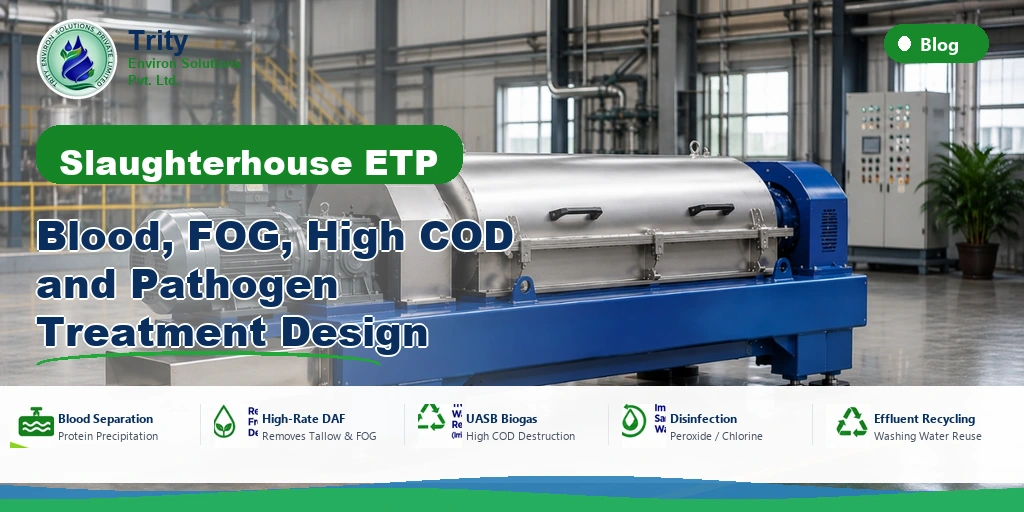
1. Strict Point-of-Source Blood Recovery: Dedicated collection troughs with vacuum suction extract 95% of liquid blood for thermal rendering into commercial blood meal fertilizer.
2. Mechanical Screening: Motorized wedge-wire rotary drum screens (0.5 to 1.0 mm) separate feathers, bone chips, visceral trimmings, and coarse manure.
3. High-Rate Dissolved Air Flotation (DAF): Injects 20 to 3
3.2 Hydraulic Retention, Flow Distribution, and Peak Surge Management
0 micron microbubbles with coagulant dosing (PAC + cationic polymer) to remove 95% of FOG and 80% of TSS.
4. Flow Equalization and Buffering Basin: Dampens diurnal slaughter surges and incorporates coarse bubble air mixing.
5. Upflow Anaerobic Sludge Blanket (UASB) Digester: Converts 80% to 85% of dissolved organic COD into high-energy methane biogas without power consumption.
6. Anoxic / Aerobic Nitrification-Denitrification MBBR: Biological removal of high ammonia-nitrogen and residual BOD.
7. Secondary Tube Settler Clarifier: Gravity biomass separation.
8. Multi-Barrier Disinfection: Inline chlorination or ozonation to guarantee complete destruction of Salmonella and enteric pathogens.
4. Sizing Calculations: 150 KLD Poultry Processing ETP
4.1 Mathematical Formulations and Governing Mass Balance
To demonstrate the exact mathematical engineering design, consider a 150 KLD poultry abattoir processing 10,000 birds daily:
Worked Engineering Design: 150 KLD Poultry Abattoir ETP
Inflow Parameters:
- Daily Inflow (Q) = 150 m3/day (10.0 m3/hr average over 15 processing hours)
- Raw Inflow BOD5 = 3,500 mg/L (525 kg BOD/day) | Raw COD = 7,500 mg/L (1,125 kg COD/day)
- Raw FOG = 1,200 mg/L (180 kg/day) | Raw TSS = 2,000 mg/L (300 kg/day)
Step 1: Dissolved Air Flotation (DAF) Sizing:
Design Surface Hydraulic Loading Rate = 4.5 m3/m2/hr.
Effective Flotation Area (A_daf) = 10.0 m3/hr / 4.5 m/hr = 2.22 m2.
Selected Dimensions: SS304 rectangular DAF unit, 2.5 m Length * 1.0 m Width * 1.6 m Depth.
Air Saturation System: 3.5 m3/hr multiphase pump delivering air-saturated water at 5.5 bar pressure (2.2 kW motor).
Performance: Removes 92% FOG (leaving < 95 mg/L) and 75% TSS, reducing raw COD by 45% (to 4,125 mg/L).
Step 2: Upflow Anaerobic Sludge Blanket (UASB) Sizing:
Inlet COD to UASB = 4,125 mg/L (618.75 kg COD/day).
Design Volumetric Orga
4.2 Step-by-Step Numerical Sizing Protocol and Worked Example
nic Loading Rate (OLR) = 7.0 kg COD per m3 reactor volume per day.
Required UASB Volume = 618.75 / 7.0 = 88.4 m3 (Round to 100 m3 gross volume).
Reactor Dimensions: Circular RCC tank, 4.8 m Diameter * 6.0 m Height (Effective volume = 108 m3).
Upflow Velocity (V_up) = 10.0 m3/hr / [pi/4 * 4.8^2] = 0.55 m/hr (Ideal range 0.5 to 0.9 m/hr).
Biogas Generation Yield: 0.38 m3 biogas per kg COD removed.
COD Removed in UASB (82% efficiency) = 507 kg COD/day -> Biogas Produced = 192 m3/day of high-methane fuel!
Step 3: Anoxic / Aerobic MBBR Biological Polishing Sizing:
Inflow to MBBR: COD = 740 mg/L (111 kg/day), BOD5 = 350 mg/L (52.5 kg/day), TKN = 95 mg/L.
Anoxic Denitrification Tank: Volume = 20 m3 (2.0 hr HRT) with 0.75 kW submersible mixer.
Aerobic MBBR Tank: Active Carrier Surface Area Loading = 16 g BOD/m2/day.
Required Media Surface Area = 52,500 g / 16 g/m2/day = 3,280 m2 of biofilm surface.
Using Virgin HDPE K3 Bio-Carriers (500 m2/m3 area): Media Volume Required = 3,280 / 500 = 6.56 m3.
At 45% filling fraction, MBBR Basin Volume = 6.56 / 0.45 = 14.6 m3 (Round to 20 m3 for 2.0 hr HRT).
Air Blower Selection: Positive displacement blower delivering 160 CFM at 0.35 bar driven by 5.5 kW motor.
5. Pathogen Disinfection and Bio-Assay Fish Survival Compliance
5.1 Stoichiometric Reaction Mechanisms and Reaction Chemistry
To eliminate bio-hazardous pathogen transmission into public surface waters, abattoir effluent must undergo rigorous terminal disinfection followed by bio-assay toxicological validation:
- Terminal Multi-Barrier Disinfection: Secondary treated effluent passes through pressurized multi-grade sand and activated carbon filtration, followed by high-rate chlorination using sodium hypochlorite at 8.0 to 10.0 ppm dosing rate inside a baffled serpentine contact chamber (30 minutes retention). Chlorination achieves complete 6-log inactivation of Salmonella, Campylobacter, and fecal coliforms (resid
5.2 Chemical Dosage Calculations and Optimization Benchmarks
ual coliforms < 10 MPN/100 mL).
- Mandatory 96-Hour Bio-Assay Fish Survival Test: CPCB slaughterhouse discharge norms strictly mandate that treated effluent undergo an in-vivo toxicological bio-assay test. Ten healthy fingerling freshwater fish (typically Cyprinus carpio or Oreochromis mossambicus) are placed in a glass aquarium containing 100% undiluted treated effluent maintained at 25 degrees Celsius with continuous aeration. Compliance mandates that at least 90% of fish survive after 96 hours of continuous exposure, proving total elimination of toxic ammonia and organic sulfides.
6. Standard Operating Procedure (SOP) for Daily Plant Operation and Blood Management
6.1 Daily Start-Up, Inspection, and Operational Shift Protocol
Maintaining biological health in an abattoir ETP requires strict execution of daily operational routines:
- Step 1: Point-of-Source Blood Sump Clearance: Ensure floor drain valves in the slaughter sticking area are dedicated strictly to the blood collection holding tank. Pump collected blood directly to the thermal rendering unit twice daily. Never hose blood clots into general floor drains.
- Step 2: Rotary Screen De-Blinding and Inspection: Clear accumulated feathers, visceral tissue, and bone fragments from the wedge-wire drum screen every two hours using an automated water wash header.
- Step 3: DAF White-Water Microbubble and Scraper Audit: Verify DAF saturation pressure remains
6.2 Preventive Maintenance, Instrument Calibration, and Safety Check
between 5.0 and 6.0 bar. Inspect the skimmed fat blanket: thickness must be maintained between 50 and 75 mm to prevent water entrainment. Skimmed grease slurry is pumped directly to the solid waste rendering cooker.
- Step 4: UASB Temperature and VFA/Alkalinity Titration: Measure UASB reactor operating temperature daily: maintain mesophilic conditions between 35 and 38 degrees Celsius. Titrate VFA/Alkalinity ratio daily: maintain strictly below 0.30.
- Step 5: Chlorine Residual and Treated Water Validation: Test free residual chlorine hourly at the effluent discharge point, maintaining between 1.0 and 2.0 mg/L. Inspect the bio-assay fish test aquarium daily, logging fish vitality and water temperature.
7. Field Troubleshooting Matrix: Resolving Abattoir Wastewater Upsets
7.1 Diagnostic Root-Cause Analysis for Common Process Upsets
When slaughterhouse ETPs experience operational deviations, plant engineers can isolate root causes using this diagnostic matrix:
7.2 Corrective Remediation Action Matrix and Operator Workflows
| Observed Plant Malfunction |
Probable Root Cause |
Diagnostic Field Test |
Engineering Corrective Action |
| Aeration basin turns dark red/brown; DO drops to 0.0 mg/L; extreme putrid stench. |
Catastrophic blood tank overflow or operator flushed whole blood into general factory drain. |
Measure inlet COD (> 25,000 mg/L) and hemoglobin spectrophotometric absorbance. |
Divert inlet to emergency holding basin. Increase DAF coagulant dose (PAC at 250 ppm) to precipitate blood proteins. Inoculate fresh active sludge. |
| DAF treated effluent contains high grease (> 150 mg/L); floating fat mats in equalization basin. |
Scalding tank washdown dumped hot water (> 65 deg C), melting fat into liquid emulsion. |
Measure DAF feed temperature (> 45 deg C). High temperature destroys microbubble attachment. |
Install a plate heat exchanger to cool scalding effluent to < 35 deg C ahead of DAF, restoring fat solidification and flotation. |
| Biological nitrification fails; treated effluent ammonia spikes > 80 mg/L; fish die in bio-assay. |
Alkalinity exhaustion in biological aeration tank (nitrification consumes 7.14 mg CaCO3 per mg NH4-N). |
Measure aeration effluent pH (< 6.2) and total alkalinity (< 50 mg/L). |
Dose sodium bicarbonate or hydrated lime into MBBR basin to maintain pH > 7.4 and alkalinity > 150 mg/L. Increase aeration DO > 2.5 mg/L. |
| Tertiary sand filter blinds within 2 hours; thick biological slime on filter media. |
Secondary clarifier solids carryover or excessive dissolved protein escaping biological degradation. |
Measure clarifier overflow turbidity (> 25 NTU) and SVI (> 200 mL/g). |
Dose 30 ppm PAC inline ahead of secondary tube settler to coagulate pin-flocs. Perform chemical chlorine backwash on sand filter. |
8. Lifecycle Capital and Operational Cost (CAPEX vs OPEX) Analysis
8.1 Core Technology Comparison and Mechanistic Distinctions
Investing in a modern, resource-recovering abattoir ETP delivers immense economic and environmental returns:
- Biogas Renewable Energy Revenue: Generating 192 m3 of methane biogas daily from a 150 KLD UASB reactor replaces approximately 100 kg of commercial LPG or 115 Liters of diesel daily in factory scalding tank burners and rendering boilers, delivering recurring fuel savings of Rs. 10.5 to 14.0 Lakhs every single year.
- Rendered By-Product Recovery: Floated tallow and fat skimmed from the DAF unit is rendered into industrial animal grease and tallow for soap manufacturing, generating secondary revenue while eliminating hazardous waste disposal costs.
- Treated Water Recycling for Lairage Washing: Passing secondary effluent through sand, carbon, and chlorine disinfection yields high-quality water (BOD < 10 mg/L, zero coliforms). Recycling 100,000 Liters daily for holding pen washing, vehicle wheel washing, and greenbelt irrigation saves over Rs. 12.0 Lakhs annually in fresh borewell extraction and municipal water costs.
8.2 Operational Efficiency, Footprint, and Capital Trade-offs
By enforcing point-of-source blood recovery, high-rate Dissolved Air Flotation, UASB anaerobic bio-energy recovery, and multi-barrier disinfection, commercial slaughterhouses achieve immaculate CPCB compliance, eliminate community odor complaints, and harvest valuable circular economy profits.
9. Rendering Plant Wastewater Treatment and Thermal Condensate Odor Scrubbing
9.1 Settling Characteristics and Solids Mass Balance Calculations
In modern meat and poultry complexes, inedible offal, feathers, bones, and.
When cooking vapors pass through barometric.
- High-Strength Organic and Ammonia Loading: Cooker.
- Dedicated Pre-Treatment Architecture: Rendering condensate is.
- Multi-Stage Chemical Odor Scrubbing: Non-condensable foul.
Design a High-Efficiency ETP for Your Slaughterhouse or Poultry Plant
9.2 Sludge Wasting Protocols, Return Ratios, and Dewatering Control
Achieve 95% FOG removal, recover clean renewable biogas, and comply with CPCB standards with Trity Environ Solutions advanced meat and poultry wastewater systems.
Get Expert Consultation
Call: +91 98188 14787
Related Technical Guides & Engineering Solutions
Explore our detailed engineering manuals and turnkey industrial plant solutions:
- High-Recovery Commercial Ro Plant Installations: Industrial engineering, manufacturing, and turnkey compliance support.
- Industrial Zero Liquid Discharge (Zld) Plant Architecture: Industrial engineering, manufacturing, and turnkey compliance support.
- Demineralized (Dm) Water Plant Systems: Industrial engineering, manufacturing, and turnkey compliance support.
- Effluent Treatment Plant (Etp) Water Recycling: Industrial engineering, manufacturing, and turnkey compliance support.
- Expert Membrane Engineering Audit And Consultation: Industrial engineering, manufacturing, and turnkey compliance support.
- Food Processing Wastewater Treatment ETP Guide: High BOD, FOG and Starch Recovery Design
- Chemical Precipitation in Industrial ETP: Coagulant and Flocculant Dosing Optimization Guide
- Rice Mill Parboiling Wastewater Treatment ETP Engineering Guide: Odor Control, UASB and SPCB Norms
- Lamella Tube Settler vs Conventional Clarifier Sizing Guide: Hazen Theory, Design and 70% Land Savings
For turnkey plant sizing, technical audits, or statutory pollution control board compliance, contact our senior process specialists for on-site environmental engineering consultation.

 ISO 9001:2015 & QCI Approved