Table of Contents: Engineering Guide & Process Index
1.1 Physico-Chemical Profile and Technical Operating Dynamics
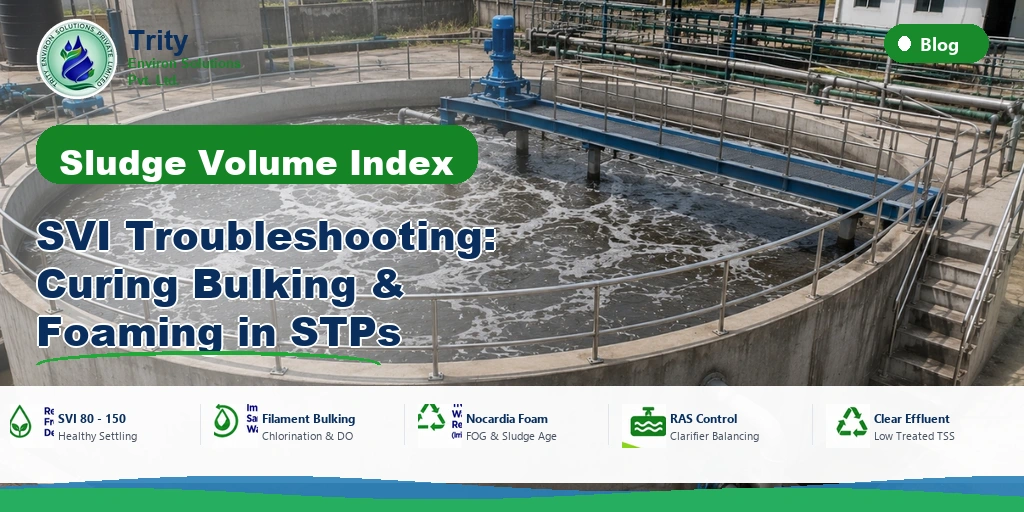
In suspended growth biological wastewater treatment systems (conventional activated sludge ASP, sequencing batch reactors SBR, and extended aeration plants), secondary clarifier performance depends entirely on the gravity settling characteristics of the biological microbial floc. Bacteria, protozoa, and rotifers must synthesize insoluble extracellular polymeric substances (EPS) that aggregate free-swimming bacterial cells into dense, compact flocs that settle rapidly, leaving a crystal-clear supernatant.
1.2 Biological and Kinetic Parameters for System Stability
When the delicate ecological balance between floc-forming bacteria (such as Zoogloea ramigera) and filamentous microorganisms (such as Type 021N, Thiothrix, Sphaerotilus natans, and Microthrix parvicella) is disrupted, sludge settleability collapses. To quantify this physical property in operational plants, environmental engineers rely on the Sludge Volume Index (SVI), developed by Mohlman in 1934 and standardized under Standard Methods for the Examination of Water and Wastewater (Method 2710 D):
- Physical Definition: SVI is defined as the volume in milliliters (mL) occupied by one gram of dry suspended activated sludge solids after settling for exactly 30 minutes in a 1,000 mL graduated cylinder.
- Direct Operational Impact: SVI dictates the maximum permissible hydraulic surface overflow rate (SOR) and solids loading rate (SLR) in the secondary clarifier. A rising SVI indicates that the biological sludge blanket is swelling, expanding, and preparing to wash out over effluent weirs into the tertiary filtration system, causing total compliance failure.
2. SVI Mathematical Formulation and Standardized 30-Minute Settleability Test
2.1 Mathematical Formulations and Governing Mass Balance
Calculating the Sludge Volume Index requires measuring two fundamental laboratory parameters:
Standard SVI Mathematical Formula:
SVI (mL/g) = [ Settled Sludge Volume after 30 min (mL/L) * 1,000 ] / [ Mixed Liquor Suspended Solids (MLSS in mg/L) ]
Where:
- SV_30 = Volume occupied by settled sludge at the 30-minute mark in a 1,000 mL cylinder (mL/L).
- MLSS = Gravimetric concentration of mixed liquor suspended solids in the aeration basin (mg/L).
- 1,000 = Unit conversion factor from grams to milligrams.
2.2 Step-by-Step Numerical Sizing Protocol and Worked Example
Standard Operational SVI Classifications:
| SVI Range (mL/g) |
Settleability Classification |
Clarifier Operational Behavior |
Secondary Effluent Quality |
| SVI < 50 mL/g |
Pin-Point / Ashing Flocs |
Rapid settling; compact, dense sludge bed |
Turbid supernatant; tiny pin-flocs carry over |
| SVI 80 to 120 mL/g |
Optimal / Ideal Operation |
Uniform blanket settling; robust underflow |
Crystal clear supernatant; BOD < 10, TSS < 10 |
| SVI 150 to 200 mL/g |
Moderate Bulking Hazard |
Slow settling; rising blanket height |
Clarifier vulnerable to peak hydraulic washout |
| SVI > 250 mL/g |
Severe Filamentous Bulking |
Zero compaction; sludge fills entire cylinder |
Catastrophic sludge washout; SPCB violation |
3. Filamentous Bulking vs Viscous Zoogloeal Bulking: Biological Mechanisms
3.1 Core Technology Comparison and Mechanistic Distinctions
Sludge bulking occurs in two distinct biological manifestations with completely different physical root causes:
- Filamentous Bulking: Occurs when long, thread-like filamentous bacteria outcompete floc-forming bacteria. These filaments extend outward from the core of the floc into the bulk liquid, acting as physical spacers that prevent neighboring flocs from touching or consolidating. The flocs become voluminous, open, web-like structures that float like clouds. Filamentous proliferation is triggered by specific environmental triggers:
- Low Dissolved Oxygen: Microscopic species like Sphaerotilus natans and Type 1701 thrive when aeration tank DO drops below 1.5 mg/L at typical organic loads.
- Nutrient Deficiency (Nitrogen / Phosphorus): Type 021N and Thiothrix dominate when the biological rati
3.2 Operational Efficiency, Footprint, and Capital Trade-offs
o of BOD5 : Nitrogen : Phosphorus falls below the mandatory 100 : 5 : 1 benchmark.
- Septic Sewage and Sulfides: Beggiatoa and Thiothrix oxidize reduced inorganic sulfur compounds present in septic, stale sewage.
- Low Food-to-Microorganism (F/M) Ratio: Microthrix parvicella and Type 0041 proliferate in under-loaded extended aeration plants where F/M drops below 0.10 kg BOD per kg MLVSS per day.
- Viscous Zoogloeal (Non-Filamentous) Bulking: Occurs when Zoogloea bacteria overproduce high-molecular-weight, water-bound extracellular polysaccharides (slime). The biomass absorbs massive amounts of bound water, swelling into a jelly-like mass with low specific gravity. This is triggered by high readily-biodegradable organic shocks coupled with severe nitrogen or phosphorus starvation.
4. Biological Foaming Dynamics: Nocardioforms, Microthrix, and Surfactants
4.1 Physico-Chemical Profile and Technical Operating Dynamics
Foaming in biological aeration basins and secondary clarifiers represents a severe operational nuisance that can shut down facilities:
4.2 Biological and Kinetic Parameters for System Stability
| Foam Characteristics |
Biological / Chemical Cause |
Microbial Identification |
Engineering Solution |
| Thick, viscous, chocolate-brown foam layer; 100 to 500 mm deep; smells earthy. |
Nocardia (Gordona amarae) or Microthrix parvicella. High sludge age (SRT > 15 days) and high FOG. |
Gram-positive and Neisser-positive branched actinomycete filaments with hydrophobic cell walls. |
Aggressively waste sludge (reduce SRT < 8 days); spray 2-3 ppm chlorine solution directly on foam; skim foam to digester. |
| White, billowing, soapy frothy foam; lightweight; blows away in wind. |
Chemical surfactants (LAS detergents) during plant startup or low MLSS / young sludge (SRT < 2 days). |
Few to no filaments present; low bacterial density in mixed liquor. |
Build up MLSS inventory; reduce sludge wasting; dose silicone or fatty-acid anti-foam temporarily. |
| Dark brown thin foam with floating black sludge clumps; bubbling gas. |
Denitrification in secondary clarifier (Rising Sludge phenomenon). |
Nitrate-N > 10 mg/L in clarifier; nitrogen gas bubbles entrapped in sludge flocs. |
Increase Return Activated Sludge (RAS) pumping rate; lower aeration basin DO slightly; add anoxic zone. |
5. Step-by-Step SOP for Conducting 30-Minute Settleability and SVI Testing
5.1 Daily Start-Up, Inspection, and Operational Shift Protocol
To obtain reliable, repeatable SVI data, laboratory technicians must execute this standardized procedure every morning:
- Step 1: Aeration Basin Sample Collection: Collect a 2-liter mixed liquor grab sample from the effluent discharge weir of the aeration basin, at the point of maximum biological mixing before entry into the clarifier feed pipe. Never sample from stagnant tank corners or foam accumulations.
- Step 2: Sample Temperature Maintenance: Perform the test immediately on-site within 10 minutes of collection. Temperature changes cause liquid degassing, bubble attachment, and altered fluid viscosity that skew settleability readings.
- Step 3: 30-Minute Settleability Measurement (SV_30): Invert the sample bottle gently three times to ensure complete homogenization. Pour mixed liquor into a standard 1,000 mL glass graduated cylinder (o
5.2 Preventive Maintenance, Instrument Calibration, and Safety Check
r specialized Settlometer) up to the 1,000 mL mark. Place the cylinder on a level, vibration-free surface out of direct sunlight. Start a digital stopwatch. Record the settled sludge interface level in milliliters at 5, 10, 15, 20, and 30 minutes. The reading at 30 minutes is the SV_30 (mL/L).
- Step 4: Gravimetric MLSS Determination: Filter a well-mixed 50 mL aliquot of the same sample through a pre-weighed 47 mm glass-fiber filter disc (Whatman 934-AH). Dry the filter pad in an oven at 103 to 105 degrees Celsius for 60 minutes. Cool in a desiccator and weigh on an analytical balance (0.1 mg accuracy). Calculate MLSS in mg/L.
- Step 5: Mathematical SVI Calculation and Logging: Divide the SV_30 volume by the MLSS concentration and multiply by 1,000. Plot daily SVI values on a process control trend chart to detect upward drift before catastrophic bulking occurs.
6. Microscopic Floc Diagnostics: Gram and Neisser Staining Identification
6.1 Engineering Principles and System Configuration
Phase contrast and brightfield microscopy provide definitive visual diagnosis of biological health:
- Floc Morphology Examination (100x Magnification): Healthy flocs are compact, rounded, firm structures (150 to 300 microns diameter) with clear, sharp perimeters and balanced filament cores that serve as structural backbones without extending into the water. Bulking flocs appear diffuse, irregular, star-shaped, or feather-like, chained together by dense filament bridges.
- Gram and Neisser Staining Protocols (1000x Oil Immersion):
- Gram Staining: Distinguishes cell wall peptidoglycan thickness. Noca
6.2 Operational Best Practices and Quality Control Benchmarks
rdia, Microthrix, and Type 021N are typically Gram-positive (retaining crystal violet purple), whereas Sphaerotilus natans and Zoogloea are Gram-negative (pink/red).
- Neisser Staining: Targets polyphosphate granules. Microthrix parvicella stains strongly Neisser-positive with blue-black granules along its entire cell chain, confirming low-load grease metabolism.
- Sulfur Granule Storage Test: Adding a drop of sodium sulfide or inspecting under phase contrast reveals yellow, highly refractive intracellular elemental sulfur granules inside Thiothrix and Beggiatoa filaments, confirming septic wastewater conditions.
7. Field Troubleshooting Matrix: Chemical and Operational Corrective Protocols
7.1 Daily Start-Up, Inspection, and Operational Shift Protocol
When SVI spikes above 180 mL/g, plant engineers must execute targeted operational adjustments:
7.2 Preventive Maintenance, Instrument Calibration, and Safety Check
| Identified Bulking Cause |
Filamentous Species |
Immediate Emergency Action |
Permanent Engineering Solution |
| Low Aeration DO (< 1.5 mg/L) |
Sphaerotilus natans, Type 1701, Haliscomenobacter |
Increase blower output; reduce raw influent feed rate by 25%. |
Upgrade aeration diffusers; maintain DO strictly between 2.0 and 2.5 mg/L across entire basin. |
| Nutrient Starvation (N / P deficiency) |
Type 021N, Thiothrix, Nostocoida limicola |
Dose urea (nitrogen source) and diammonium phosphate (DAP) immediately. |
Install automated nutrient dosing system maintaining BOD : N : P ratio strictly at 100 : 5 : 1. |
| Septic Influent and High Sulfides |
Thiothrix, Beggiatoa, Type 0914 |
Pre-chlorinate raw sewage (5 ppm) or dose ferric chloride into collection sump. |
Install air-mixing diffusers in equalization tank to eliminate anaerobic septic pockets. |
| Severe Persistent Bulking Emergency |
Mixed Heavy Filamentous Infestation (SVI > 300) |
RAS Chlorination: Dose 2.0 to 4.0 kg Cl2 per 1,000 kg MLSS into the return sludge line. |
Dose chlorine until microscopic exam shows filament sheath breakage; halt dosing to prevent deflocculation. |
8. Economic Impact of SVI Management on Tertiary Treatment and CPCB Norms
8.1 Statutory CPCB and SPCB Discharge Quality Standards
Maintaining SVI within the optimal 80 to 120 mL/g window delivers massive financial and operational benefits:
- Tertiary Filtration Operating Savings: When SVI spikes above 200 mL/g, pin-floc carryover increases tertiary sand filter backwashing frequency from once every 24 hours to once every 3 hours. This consumes up to 25% of total plant treated water for backwashing, cycling sludge repeatedly through the headworks and tripling backwash pump electricity consumption.
- Sludge Dewatering Efficiency: Bulking sludge with high bound-water content exhibits poor dewatering characteristics on belt filter presses and centrifuges. Achieving 18% cake solids requires doubling flocculant polymer dosing from 2.5 kg/ton to 6.0 kg/ton, adding over Rs. 3.5 Lakhs annually in chemical expenses for a 1,000 KLD plant.
- Eliminating NGT Environmental Penalties: Solids washout resulting from unmanaged sludge bulking triggers instant non-compliance with Central Pollution Control Board standards (mandating TSS < 10 mg/L and BOD < 10 mg/L). Fines levied by State Pollution Control Boards and the National Green Tribunal can exceed Rs. 5 to 10 Lakhs per month of non-compliance.
8.2 Continuous Online Monitoring (OCEMS) and Compliance Audits
By conducting daily 30-minute settleability testing, tracking SVI trends, maintaining nutrient stoichiometry, and executing targeted RAS chlorination during emergencies, plant engineers maintain robust biological health, crystal-clear treated effluent, and flawless regulatory compliance.
9. Biological Selector Basin Engineering: Aerobic, Anoxic and Anaerobic Kinetic Selectors
9.1 Engineering Principles and System Configuration
While chemical dosing (such as chlorine or hydrogen peroxide) halts acute filamentous bulking in an emergency, permanent long-term bulking prevention requires the engineering integration of a biological selector tank upstream of the main aeration basin. Biological selectors exploit fundamental differences in kinetic enzyme uptake rates between floc-forming bacteria and filamentous microorganisms.
Floc-forming bacteria possess high substrate uptake rates (high maximum specific growth rate, mu_max), allowing them to rapidly absorb and store large quantities of soluble substrate within minutes when exposed to high substrate concentrations. Conversely, filamentous bacteria possess low growth rates but high substrate affinities (low saturation constant, Ks), allowing them to outgrow floc formers only under continuous low-substrate, completely mixed environments:
- Aerobic Kinetic Selector: Consists of a series of two to three small, intensely aerated contact compartments (hydraulic retention time of 15 to 30 minutes total) located immediately ahead of the main aeration basin. Return Activated Sludge (RAS) and raw wastewater mix violently under high dissolved oxygen (> 2.5 mg/L), creating a severe localized food-to-microorganism concentration gradient. Floc-forming bacteria rapidly absorb 80% of soluble BOD, starving the filaments and completely suppressing filamentous growth in the downstream main basin.
- Anoxic Biological Selector: Utilizes nitrate present in the RAS as an electron acceptor under zero dissolved oxygen conditions (retention time of 30 to 60 minutes with low-speed submersible mixers). Most problematic filamentous species (including Sphaerotilus natans and Type 1701) are obligate aerobes incapable of utilizing nitrate for respiration. In contrast, facultative floc-forming denitrifiers metabolize.
- Anaerobic Selector (Bio-P Removal): Operating under.
Restore Your Biological Clarifier Stability and Settleability
9.2 Operational Best Practices and Quality Control Benchmarks
Eliminate filamentous bulking, control Nocardia foaming, and optimize SVI settleability with Trity Environ Solutions advanced biological wastewater diagnostics.
Get Expert Consultation
Call: +91 98188 14787
Related Technical Guides & Engineering Solutions
Explore our detailed engineering manuals and turnkey industrial plant solutions:
- Commercial Sewage Treatment Plant (Stp) Solutions: Industrial engineering, manufacturing, and turnkey compliance support.
- Commercial Ro Plant Systems: Industrial engineering, manufacturing, and turnkey compliance support.
- Industrial Water Softener Systems: Industrial engineering, manufacturing, and turnkey compliance support.
- Environmental Engineering Consultation With Trity Enviro: Industrial engineering, manufacturing, and turnkey compliance support.
- MLSS and F/M Ratio Management in Activated Sludge STPs: Engineering Operating Manual
- Submersible Aerators vs Surface Aerators in Wastewater Aeration Basins: Sizing, OTE and Energy Efficiency Guide
- Lamella Tube Settler vs Conventional Clarifier Sizing Guide: Hazen Theory, Design and 70% Land Savings
- STP Commissioning Checklist: Seeding, Acclimatization and 7-Day Performance Testing Guide
For turnkey plant sizing, technical audits, or statutory pollution control board compliance, contact our senior process specialists for on-site environmental engineering consultation.