Table of Contents: Engineering Guide & Process Index
1. Agro-Industrial Effluent Profile of Parboiled Rice Processing Mills
1.1 Physico-Chemical Profile and Technical Operating Dynamics
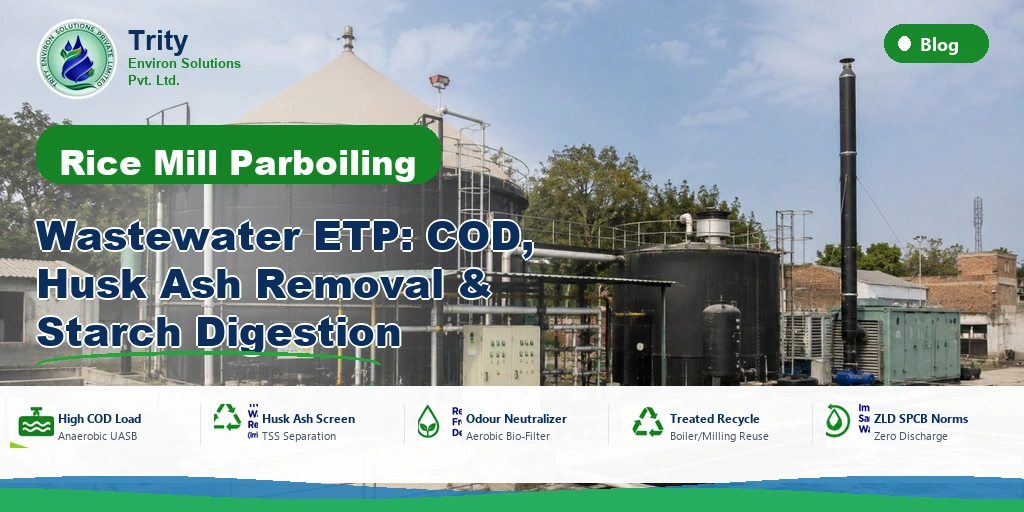
India is the world's leading producer and exporter of parboiled rice, concentrated across agro-industrial belts in Punjab, Haryana, Uttar Pradesh, Chhattisgarh, Odisha, Andhra Pradesh, and West Bengal. The parboiling process involves three hydrothermal processing stages: paddy soaking (steeping raw paddy in warm water at 60 to 70 degrees Celsius for 8 to 12 hours), steam conditioning under pressure (hydrolyzing and gelatinizing starchy endosperms), and mechanical drying before hulling and polishing.
1.2 Biological and Kinetic Parameters for System Stability
The soaking and boiler condensate discharge generates extreme quantities of high-strength organic wastewater, classified under the Central Pollution Control Board (CPCB) Orange and Red industrial categories. A typical 100 metric ton per day (TPD) parboiled rice mill discharges between 100 and 150 cubic meters (kL) of parboiling soak wastewater daily, presenting severe environmental challenges:
- Extreme Chemical and Biochemical Oxygen Demand: Raw soaking effluent exhibits Biochemical Oxygen Demand (BOD5) ranging from 1,200 to 3,500 mg/L and Chemical Oxygen Demand (COD) between 2,500 and 7,500 mg/L, driven by dissolved amylose starches, soluble proteins, and degraded grain hulls.
- High Total Suspended Solids (TSS): Contains between 800 and 2,500 mg/L of short rice bran particles, fine grain dust, and colloidal starch suspensions that ferment rapidly.
- Pungent Odor and Anaerobic Acidification: Due to extended steeping at warm temperatures, lactic acid bacteria naturally ferment starches, dropping wastewater pH to between 4.0 and 5.2. As the effluent becomes septic, anaerobic microbes produce volatile organic acids (butyric, propionic, and valeric acids) and hydrogen sulfide (H2S), releasing a nauseating, rotten-grain stench that triggers immediate village protests and SPCB closure notices.
2. SPCB & CPCB Environmental Discharge Norms for Rice Mills
2.1 Statutory CPCB and SPCB Discharge Quality Standards
Under the Environment (Protection) Rules, 1986 and State Pollution Control Board guidelines, parboiled rice mills face stringent effluent discharge ceilings:
| Environmental Parameter |
Raw Parboiling Soak Water |
Inland Surface Water Norm |
On-Land Irrigation Norm |
| pH Value |
4.0 to 5.2 (Acidic fermentation) |
6.5 to 8.5 |
6.0 to 8.5 |
| Biochemical Oxygen Demand (BOD5) |
1,500 to 3,500 mg/L |
< 30 mg/L |
< 100 mg/L |
| Chemical Oxygen Demand (COD) |
3,000 to 7,500 mg/L |
< 250 mg/L |
N/A (SPCB governed) |
| Total Suspended Solids (TSS) |
800 to 2,500 mg/L |
< 50 mg/L |
< 100 mg/L |
| Oil and Grease (FOG) |
30 to 120 mg/L |
< 10 mg/L |
< 10 mg/L |
| Total Dissolved Solids (TDS) |
1,800 to 3,500 mg/L |
< 2,100 mg/L |
< 2,100 mg/L |
2.2 Continuous Online Monitoring (OCEMS) and Compliance Audits
Discharging untreated acidic soak wastewater into local nullahs or unlined lagoons leads to rapid soil salinization, groundwater contamination, and mandatory factory sealing by district magistrates under the Water (Prevention and Control of Pollution) Act, 1974.
3. Process Design Architecture: UASB Anaerobic Digestion + Aerobic MBBR System
3.1 Mechanical Equipment Specifications and Component Sizing
Because parboiling wastewater contains easily biodegradable dissolved starches and sugars with high BOD:COD ratios (typically 0.45 to 0.55), attempting to treat raw soak water using purely aerobic systems is economically catastrophic, requiring massive electrical power consumption for blowers. Modern engineering deploys an integrated anaerobic-aerobic multi-barrier treatment train:
Process Flow Architecture:
1. Rotary Wedge-Wire Drum Screen (0.5 mm mesh) -> Captures husk and grain solids.
2. Grit and Fat/Oil Separator Chamber -> Removes surface bran waxe
3.2 Hydraulic Retention, Flow Distribution, and Peak Surge Management
s.
3. Flow Equalization and Pre-Acidification Tank -> Hydraulic buffering + coarse bubble air mixing.
4. Chemical Neutralization Tank -> Lime dosing to correct pH from 4.5 to 7.0.
5. High-Rate Upflow Anaerobic Sludge Blanket (UASB) Reactor -> 80% to 85% COD destruction + Biogas generation.
6. Moving Bed Biofilm Reactor (MBBR) Aerobic Tank -> Biological polishing of residual BOD to sub-30 mg/L.
7. Secondary Tube Settler Clarifier -> Gravity separation of biomass flocs.
8. Tertiary Multi-Grade Sand & Activated Carbon Filtration -> Polishing to sub-10 mg/L TSS and complete odor elimination.
9. Pressure Sludge Dewatering (Filter Press) -> Solid dewatered cake for organic composting.
4. Sizing Calculations: 100 KLD Parboiled Rice Mill ETP
4.1 Mathematical Formulations and Governing Mass Balance
To establish exact equipment dimensions, consider the engineering sizing for a 100 KLD parboiled rice mill operating 20 hours daily:
Worked Engineering Design: 100 KLD Rice Mill ETP
Inflow Parameters:
- Daily Effluent (Q) = 100 m3/day (5.0 m3/hr average over 20 hours)
- Inlet BOD5 = 2,000 mg/L (200 kg/day) | Inlet COD = 4,500 mg/L (450 kg/day)
- Target Treated Effluent: BOD < 30 mg/L, COD < 250 mg/L, TSS < 50 mg/L.
Step 1: Equalization Basin Sizing (HRT = 16 hours due to batch soak dumping):
Required Volume = 100 m3 * (16 hr / 24 hr) = 66.7 m3. Applying 15% safety buffer: V_eq = 80 m3.
Civil Dimensions: 6.0 m Length * 4.5 m Width * 3.5 m Liquid Depth (plus 0.5 m freeboard).
Air Mixing Requirement: 80 m3 * 1.5 Nm3/m3/hr = 120 Nm3/hr (70 CFM) at 0.4 bar.
Blower Selection: 2.2 kW (3.0 HP) twin-lobe rotary blower with SS304 coarse bubble diffusers.
Step 2: Upflow Anaerobic Sludge Blanket (UASB) Sizing:
Design Organic Loading Rate (OLR) = 6.0 kg COD per m3 reactor volume per day.
Total Daily COD Mass = 450 kg COD/day.
Required UASB Volume = 4
4.2 Step-by-Step Numerical Sizing Protocol and Worked Example
50 kg / 6.0 kg/m3/day = 75.0 m3.
Assuming effective height H = 5.5 meters -> Cross-Sectional Area = 75 / 5.5 = 13.6 m2.
Selected Dimensions: Circular RCC reactor, Diameter = 4.2 meters, Total Height = 6.0 meters.
Upflow Velocity (V_up) = 5.0 m3/hr / 13.6 m2 = 0.37 m/hr (Ideal range 0.4 to 0.8 m/hr).
Biogas Generation Yield: 0.35 m3 CH4 per kg COD removed.
COD Removed in UASB (80% efficiency) = 360 kg COD/day -> Biogas Produced = 126 m3/day of high-BTU fuel!
Step 3: Aerobic MBBR Polishing Tank Sizing:
Inflow to MBBR: COD = 900 mg/L (90 kg/day), BOD5 = 350 mg/L (35 kg/day).
Target Effluent BOD = 20 mg/L -> BOD to Remove = 33 kg/day.
Design Carrier Surface Area Loading Rate (SALR) = 15 g BOD/m2 media surface per day.
Required Media Surface Area = 33,000 g / 15 g/m2/day = 2,200 m2 of active biofilm area.
Using Virgin HDPE K3 Bio-Media (Specific surface area = 500 m2/m3):
Media Volume Required = 2,200 / 500 = 4.4 m3 of K3 media.
At 50% media filling fraction, MBBR Basin Volume = 4.4 / 0.50 = 8.8 m3 (Round to 12.0 m3 for 2.4 hr HRT).
Civil Dimensions: 2.5 m Length * 2.0 m Width * 2.5 m Depth.
Air Requirement: Fine bubble EPDM tubular diffusers powered by a 3.7 kW (5.0 HP) blower (110 CFM at 0.3 bar).
5. Biogas Recovery, Renewable Energy Economics, and Boiler Fuel Substitution
5.1 Capital Expenditure (CAPEX) Breakdown and Component Sizing
One of the most compelling economic advantages of an engineered parboiled rice mill ETP is the generation of high-energy methane biogas during anaerobic digestion. While paddy husk feeds the main steam boilers, methane gas recovered from the UASB reactor provides high-grade supplementary thermal fuel:
- Biogas Composition: Biogas generated from rice starch digestion contains 65% to 72% methane (CH4), 26% to 32% carbon dioxide (CO2), and less than 500 ppm hydrogen sulfide (H2S). The gross calorific value ranges from 5,200 to 5,800 kcal/m3.
- Thermal
5.2 Operational Expenditure (OPEX) Optimization and Payback Analysis
Equivalent: For a 100 KLD mill producing 126 cubic meters of biogas daily, the energy equivalent equals approximately 65 kg of LPG, 70 Liters of industrial diesel, or 350 kg of raw paddy husk daily.
- Boiler Burner Retrofit: Recovered biogas is piped from the UASB three-phase separator dome through a moisture trap, gravel flame arrestor, and mechanical desulfurization scrubber (iron sponge / ferric hydroxide pellets) into dual-fuel burners on the boiler, saving lakhs of rupees annually in auxiliary fuel costs while eliminating greenhouse gas emissions.
6. Standard Operating Procedure (SOP) for Daily Plant Operation and Lime Neutralization
6.1 Daily Start-Up, Inspection, and Operational Shift Protocol
Maintaining stable parboiling ETP operation requires strict adherence to daily standard operating procedures:
- Step 1: Rotary Drum Screen De-Blinding: Inspect the wedge-wire drum screen every two hours. Clear accumulated husk and bran cakes using an automated high-pressure spray nozzle header to prevent overflow flooding.
- Step 2: Automated Lime Neutralization Calibration: Because soak water is naturally acidic (pH 4.2 to 4.8), anaerobic methanogenic bacteria in the UASB reactor will suffer immediate acid toxicity if pH drops below 6.6. Maintain continuous hydrated lime slurry dosing (10% solution strength) in the neutralization chamber controlled by an automated pH controller, maintaining UASB feed pH strictly between 6.8 and 7.2.
- Step 3: UASB Sludge Blanket Level and VFA/Alkalinity Titration: Measure the anaerobic granular sludge blanket height bi-weekly using a core-sampling sludge judge. Conduct daily laboratory titration of Volatile Fatty Acids (VFA) a
6.2 Preventive Maintenance, Instrument Calibration, and Safety Check
nd Total Alkalinity (as CaCO3). Maintain the VFA/Alkalinity ratio strictly below 0.30. A ratio spiking above 0.40 indicates imminent digester souring, requiring immediate feed reduction and supplemental sodium bicarbonate dosing.
- Step 4: MBBR Dissolved Oxygen and Biofilm Inspection: Measure dissolved oxygen in the aerobic MBBR tank every 4 hours, maintaining DO between 2.0 and 2.5 mg/L. Inspect the moving plastic bio-carriers: healthy bio-media exhibits a dark chocolate-brown, velvety microbial biofilm. Pale or sloughing biofilm indicates nutrient starvation or shock organic loads.
- Step 5: Clarifier Sludge Evacuation and Filter Press Operation: Transfer settled biomass from the secondary tube settler hopper twice daily to the sludge holding tank. Dose 0.1% cationic flocculant polymer and pump slurry into the recessed chamber filter press at 7.0 bar pressure until clear filtrate stops dripping. Release dry, odor-free cake (32% solids) for on-site agricultural soil conditioning.
7. Field Troubleshooting Matrix: Resolving Rice Mill ETP Operational Upsets
7.1 Diagnostic Root-Cause Analysis for Common Process Upsets
When plant performance deviates from design standards, operators can isolate and rectify faults using this field diagnostic protocol:
7.2 Corrective Remediation Action Matrix and Operator Workflows
| Observed Plant Fault |
Probable Root Cause |
Diagnostic Field Test |
Engineering Corrective Action |
| Nauseating sour odor across factory boundary; community complaints. |
Soak water turning septic in equalization tank; lactic acid fermentation and H2S outgassing. |
Measure equalization tank pH (< 4.5) and dissolved oxygen (0.0 mg/L). |
Increase equalization air blower CFM. Dose 20 ppm sodium hypochlorite or hydrogen peroxide into inlet sewer. Cover tank and install wet scrubber. |
| UASB reactor turns sour; gas production drops by 80%; effluent pH drops below 6.0. |
Volatile fatty acid accumulation caused by sudden organic overload or lime dosing pump failure. |
Titrate VFA/Alkalinity ratio (exceeds 0.50). Measure volatile acids (> 1,000 mg/L). |
Stop wastewater feed immediately. Recirculate treated effluent. Dose sodium bicarbonate (not caustic soda) until pH reaches 7.2 and VFA drops < 0.25. |
| Secondary clarifier overflow is turbid; fine pin-flocs carry over into sand filter. |
Nutrient deficiency in MBBR aerobic stage (rice soak water is deficient in nitrogen and phosphorus). |
Test aeration effluent for soluble ammonia (NH4-N < 1.0 mg/L) and phosphate (PO4-P < 0.2 mg/L). |
Dose agricultural urea and diammonium phosphate (DAP) into MBBR feed to maintain BOD:N:P strictly at 100:5:1. |
| Tertiary sand filter blinds within 4 hours; high backpressure (> 1.5 bar). |
Excessive un-degraded starch and colloidal particles passing through clarifier. |
Perform iodine test on clarifier effluent (turns dark blue/purple, indicating unhydrolyzed starch). |
Dose 30 ppm Polyaluminium Chloride (PAC) inline ahead of secondary tube settler to coagulate starches. |
8. Lifecycle Capital and Operational Cost (CAPEX vs OPEX) Analysis
8.1 Core Technology Comparison and Mechanistic Distinctions
Investing in a high-efficiency anaerobic-aerobic ETP delivers exceptional financial and regulatory returns for parboiled rice mill owners:
- Power Consumption Savings: Operating a UASB anaerobic reactor destroys 80% of the dissolved organic load without consuming any electrical aeration power. In contrast, an un-engineered, purely aerobic extended aeration plant treating a 100 KLD mill requires over 22 kW of continuous blower power, incurring annual electricity bills exceeding Rs. 14.5 Lakhs. The UASB-MBBR combined system slashes operational power demand to just 7.5 kW, delivering recurring power savings of Rs. 9.5 Lakhs annually.
- Treated Water Recycling for Boiler Feed and Soaking: Passing secondary effluent through multi-grade sand filtration, activated carbon, and disinfection produces high-clarity water (BOD < 10.
- Organic Fertilizer By-Product: Dewatered UASB and.
By coupling fine rotary pre-screening, automated.
Design a High-Efficiency ETP for Your Parboiled Rice Mill
8.2 Operational Efficiency, Footprint, and Capital Trade-offs
Eliminate foul soak water odors, recover clean renewable biogas, and comply with CPCB standards with Trity Environ Solutions specialized agro-industrial ETP systems.
Get Expert Consultation
Call: +91 98188 14787
Related Technical Guides & Engineering Solutions
Explore our detailed engineering manuals and turnkey industrial plant solutions:
- High-Recovery Commercial Ro Plant Installations: Industrial engineering, manufacturing, and turnkey compliance support.
- Industrial Zero Liquid Discharge (Zld) Plant Architecture: Industrial engineering, manufacturing, and turnkey compliance support.
- Demineralized (Dm) Water Plant Systems: Industrial engineering, manufacturing, and turnkey compliance support.
- Effluent Treatment Plant (Etp) Water Recycling: Industrial engineering, manufacturing, and turnkey compliance support.
- Expert Membrane Engineering Audit And Consultation: Industrial engineering, manufacturing, and turnkey compliance support.
- Chemical Precipitation in Industrial ETP: Coagulant and Flocculant Dosing Optimization Guide
- Lamella Tube Settler vs Conventional Clarifier Sizing Guide: Hazen Theory, Design and 70% Land Savings
- Pulp and Paper Mill ETP: Lignin Removal, Colour Reduction and Fiber Recovery Engineering Guide
- Food Processing Wastewater Treatment ETP Guide: High BOD, FOG and Starch Recovery Design
For turnkey plant sizing, technical audits, or statutory pollution control board compliance, contact our senior process specialists for on-site environmental engineering consultation.

 ISO 9001:2015 & QCI Approved