Table of Contents: Engineering Guide & Process Index
1. Critical Medical Significance of Dialysis Water Purity and Patient Exposure
1.1 Physico-Chemical Profile and Technical Operating Dynamics
Hemodialysis is a life-sustaining renal replacement therapy for patients suffering from End-Stage Renal Disease (ESRD) and acute kidney injury. In modern hospital dialysis centers, an average dialysis patient is exposed to between 360 and 600 Liters of purified dialysate water every week (compared to normal human oral water consumption of only 14 Liters weekly). During high-flux hemodialysis, this massive water volume is separated from the patient's bloodstream across an ultra-thin (10 to 30 micron) semi-permeable artificial kidney dialyzer membrane.
Because the protective gastrointestinal epithelial barrier and liver detoxification pathways are completely bypassed during treatment, contaminants present in dialysis water diffuse directly across the dialyzer membrane into the patient's blood:
- Endotoxin and Pyrogenic Shock: Gram-negative bacterial cell wall fragments (lipopolysaccharides, LPS / endotoxins) cross porous dialyzer membranes, triggering massive cytokine cascades that induce violent pyrogenic reactions, shivering, hypotensive shock, and chronic systemic cardiovascular inflammation.
- Chemical Toxicity (Chloramines and Metals): Trace free chlorine and chloramines oxidize red blood cell membranes, precipitating catastrophic acute hemolytic anemia and methemoglobinemia. Trace aluminum causes dialysis encephalopathy and severe osteomalacia, while excess copper or zinc causes acute liver necrosis.
1.2 Biological and Kinetic Parameters for System Stability
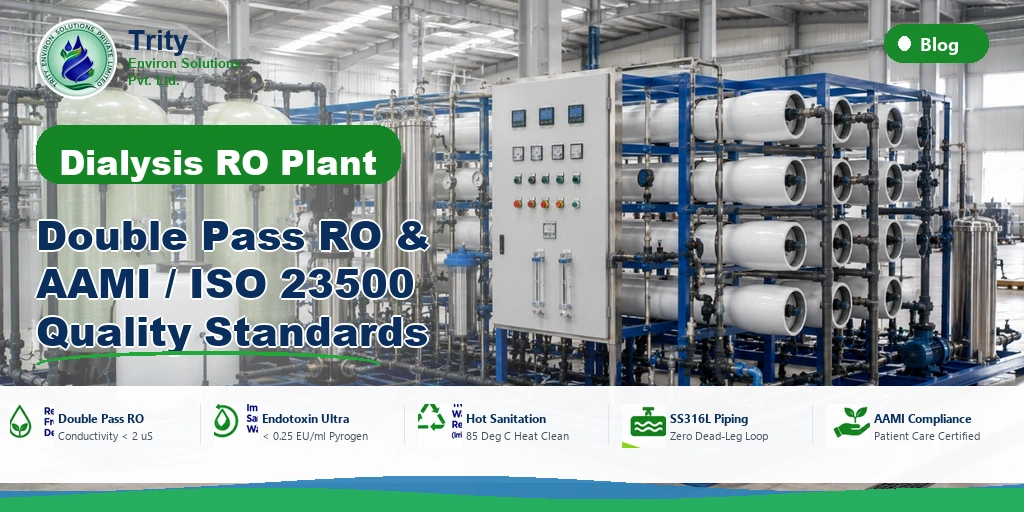
To ensure total patient safety, modern clinical water treatment facilities mandate an integrated, multi-barrier Double-Pass Reverse Osmosis (DPRO) architecture adhering strictly to international medical standards.
2. International Regulatory Standards: ANSI/AAMI/ISO 23500 Compliance Limits
2.1 Statutory CPCB and SPCB Discharge Quality Standards
Medical water treatment systems in hospital nephrology suites must comply with the globally harmonized ANSI/AAMI/ISO 23500:2019 and Indian Pharmacopoeia (IP) water quality standards:
2.2 Continuous Online Monitoring (OCEMS) and Compliance Audits
| Quality Parameter |
Municipal Potable Water Baseline |
AAMI / ISO 23500 Standard Water |
Ultrapure Dialysis Water Standard |
| Total Viable Bacterial Count (TVC) |
< 500 CFU/mL |
< 100 CFU/mL (Action level: 50) |
< 0.1 CFU/mL (Ultra-sterile) |
| Bacterial Endotoxin Concentration |
Unregulated (Often > 5.0 EU/mL) |
< 0.25 EU/mL (Action level: 0.125) |
< 0.03 EU/mL (Endotoxin-Free) |
| Total Chlorine (Free + Chloramines) |
0.5 to 2.0 mg/L |
< 0.10 mg/L (Critical threshold) |
< 0.02 mg/L (Zero detection) |
| Aluminum (Al) |
< 0.20 mg/L |
< 0.01 mg/L (10 ppb) |
< 0.01 mg/L |
| Conductivity / Electrical Resistivity |
500 to 1,500 uS/cm |
< 10.0 uS/cm (at 25 deg C) |
< 2.0 uS/cm (> 0.5 Mega-ohm*cm) |
| Heavy Metals (Lead, Copper, Zinc) |
< 0.05 mg/L |
< 0.005 mg/L (Sub-ppm trace) |
< 0.001 mg/L |
3. Double-Pass Reverse Osmosis (DPRO) Flow Architecture and Mechanical Redundancy
3.1 Mechanical Equipment Specifications and Component Sizing
Single-pass reverse osmosis systems are medically unsafe for hospital hemodialysis: a single pinhole membrane leak, O-ring seal rupture, or raw water surge allows immediate contaminant breakthrough directly into patient lines. Modern clinical standards mandate a Double-Pass Reverse Osmosis (DPRO) configuration with 100% mechanical redundancy:
Double-Pass Flow Path:
1. Raw Municipal Feed -> Media Pre-Treatment Train (Dual Water Softener + Dual GAC Carbon Beds).
2. Pass 1 High-Pressure Pump -> Pass 1 Polyamide RO Elements (Operating at 65% to 75% Recovery).
3. Pass 1 Permeate Buffer Break Tank (Conductivity reduced from 800 to 15 uS/cm, 98% salt rejection).3.2 Hydraulic Retention, Flow Distribution, and Peak Surge Management
r>
4. Pass 2 High-Pressure Pump -> Pass 2 Low-Energy RO Elements (Treating Pass 1 Permeate as Feed Water!).
5. Pass 2 Permeate (Conductivity < 1.5 uS/cm, TDS < 2 ppm, Endotoxin < 0.03 EU/mL) -> Distribution Loop.
6. Pass 2 Reject Water Recycling: Because Pass 2 reject consists of partially purified water, it is recycled 100% back to the Pass 1 feed header, achieving an overall plant water recovery exceeding 80% to 85%!
Mechanical Hot-Standby Redundancy (N+1 Architecture):
The DPRO skid incorporates motorized 3-way isolation valves controlled by PLC. If Pass 1 suffers an electrical or membrane fault, the system automatically reconfigures into single-pass high-rejection mode using Pass 2 alone, ensuring the hospital nephrology unit never suffers water interruption during live patient sessions.
4. Pre-Treatment Engineering: Dual Softening, GAC Dechlorination and Sub-Micron Filtration
4.1 Engineering Principles and System Configuration
Protecting the DPRO membranes and satisfying strict chlorine limits requires a robust pre-treatment train:
- Duplex Water Softeners (Series / Alternating Mode): Operating in automatic duplex configuration with food-grade strong acid cation (SAC) resin in sodium form. Reduces raw total hardness from 300 mg/L down to strictly sub-1.0 mg/L (Zero Hardness). When hardness exceeds 5.0 mg/L, calcium scaling chokes the Pass 1 lead elements within days.
- Dual Granular Activated Carbon (GAC) Beds in Series: Total chlorine removal is life-critical. Two identical GAC vessels (Worker and Polisher) fa
4.2 Operational Best Practices and Quality Control Benchmarks
bricated from virgin coconut-shell carbon (minimum Iodine Value of 1,050 mg/g) are operated in series to guarantee an Empty Bed Contact Time (EBCT) of at least 10 minutes (minimum 5 minutes per vessel at peak flow). The secondary polisher vessel guarantees zero chlorine breakthrough (< 0.05 ppm) even if the primary worker vessel exhausts unexpectedly.
- Security Sub-Micron Cartridge Filters: Dual sanitary filter housings fitted with 1.0-micron and 0.2-micron absolute-rated pleated polyethersulfone (PES) filter cartridges capture microscopic carbon fines and resin beads before entering high-pressure pumps.
5. Distribution Loop Engineering: SS316L Sanitary Piping and Zero Dead-Leg Rules
5.1 Engineering Principles and System Configuration
Generating ultrapure water is futile if the distribution piping allows bacterial biofilm colonization. Biofilms synthesize extracellular polymeric substances (EPS) that release endotoxins continuously into dialyzer feed drops:
- Sanitary Piping Material (SS316L vs PVDF): PVC, CPVC, and rubber hoses must NEVER be used in medical dialysis loops because plasticizers leach into the water and rough solvent-cemented pipe joints harbor bacterial colonies. Distribution loops must be constructed exclusively from pharmaceutical-grade SS316L stainless steel (electro-polished to Ra < 0.4 microns) or high-purity virgin Polyvinylidene Fluoride (PVDF) joined using clean infrared (IR) fusion welding.
<
5.2 Operational Best Practices and Quality Control Benchmarks
li>The Six-Diameter (6D) Zero Dead-Leg Rule: Branch take-offs connecting to individual hemodialysis machine bibb stations must adhere to the 6D rule (branch length must not exceed 6 times the pipe diameter, preferably zero-deadleg sanitary diaphragm block valves) to prevent stagnant pockets of resting water.
- Continuous Turbulent Recirculation: Ultrapure water must circulate continuously 24 hours a day, 7 days a week through a closed return loop back to the RO break tank. Piping is sized to maintain a continuous return velocity exceeding 1.0 to 1.5 meters per second (Reynolds Number > 10,000) to physically prevent bacterial attachment and biofilm adhesion to pipe walls.
6. Thermal Disinfection vs Chemical Sanitization: The 85 Degrees Celsius Heat Protocol
6.1 Stoichiometric Reaction Mechanisms and Reaction Chemistry
Controlling bio-contamination in dialysis distribution loops requires periodic sanitization. Historically, chemical disinfectants (peracetic acid, sodium hypochlorite, formaldehyde) were injected into loops. However, chemical sanitization requires hours of post-flush testing to ensure zero chemical residual reaches patients, presenting severe toxic risks.
6.2 Chemical Dosage Calculations and Optimization Benchmarks
Modern clinical DPRO systems incorporate automated Thermal Hot-Water Disinfection:
- Heating Cycle: Water circulating in the SS316L distribution loop is heated by an in-line electric sanitary heat exchanger up to 85 to 90 degrees Celsius.
- Thermal Dwell Time: Heated water at 85 degrees Celsius is circulated continuously through all machine drop valves for a dwell time of 60 to 90 minutes. Thermal energy destroys bacterial cell membranes and thermal-sensitive endotoxins without adding any toxic chemical agents.
- Automated Cool-Down: A sanitary plate chiller cools the circulating water back down to 22 degrees Celsius prior to morning patient shifts. The entire cycle is controlled automatically by PLC during night hours, completely eliminating chemical handling, testing errors, and patient exposure hazards.
7. Field Troubleshooting Matrix: Resolving Dialysis Water Purity Failures
7.1 Diagnostic Root-Cause Analysis for Common Process Upsets
When monitoring reveals water quality excursions, clinical engineers must isolate root causes immediately using this diagnostic matrix:
7.2 Corrective Remediation Action Matrix and Operator Workflows
| Observed Quality Alarm |
Probable Root Cause |
Diagnostic Field Test |
Immediate Clinical Corrective Action |
| Total chlorine detected at primary carbon bed outlet (> 0.10 mg/L). |
Primary activated carbon bed exhausted; municipal water utility surged chlorine. |
Test secondary carbon polisher outlet (must read 0.0 mg/L). Verify EBCT contact time. |
Rotate beds: shift secondary vessel to primary position; replace spent carbon in primary vessel with fresh virgin coconut GAC. |
| Bacterial endotoxin test in distribution loop fails (> 0.25 EU/mL); patient chills reported. |
Biofilm colonization inside distribution loop piping dead-legs or final endotoxin ultrafilter exhausted. |
Limulus Amebocyte Lysate (LAL) testing at individual dialysis machine drop points to isolate contaminated line. |
Halt patient sessions. Execute 90-minute hot-water thermal sanitization at 88 deg C. Replace point-of-use (POU) endotoxin ultrafilter cartridges. |
| Pass 2 permeate conductivity jumps from 1.2 uS/cm to 8.5 uS/cm; resistivity drops. |
Pass 1 membrane scaling or Pass 2 high-pressure pump seal bypass. |
Measure Pass 1 permeate conductivity (> 25 uS/cm indicates Pass 1 membrane failure). |
Check softener effluent hardness. Perform chemical CIP on Pass 1 membranes with citric acid. Replace damaged RO elements. |
| Water softener outlet hardness test turns blue/purple; hardness > 5.0 mg/L. |
Brine tank salt bridging or brine suction injector choked with insoluble rock salt dirt. |
Check brine tank liquid level and salt inventory. Test brine suction draw during regeneration. |
Break salt bridge manually. Clean brine injector nozzle. Switch to standby softener and initiate manual brine regeneration. |
8. Microbiological Validation: LAL Endotoxin Testing and Heterotrophic Plate Counts
8.1 Engineering Principles and System Configuration
Maintaining accredited clinical compliance requires hospital nephrology units to enforce a disciplined microbiological sampling schedule:
- Limulus Amebocyte Lysate (LAL) Endotoxin Assay: Conduct quantitative kinetic chromogenic or turbidimetric LAL testing bi-weekly on samples collected from the RO permeate, the return distribution loop, and point-of-use dialysis bibb taps. Water must strictly exhibit endotoxin concentrations < 0.25 EU/mL (standard water) and < 0.03 EU/mL (ultrapure water).
- Heterotrophic Plate Counts (HPC) with R2A Agar: Standard nutrient agar incubated at 37 degrees Celsius for 24 hours fails to detect slow-growing oligotrophic aquatic bacteria. Compliance testing mandates plating water on low-nutrient R2A agar incubated at 20 to 22 degrees Celsius for a minimum of 5 to 7 days, ensuring total viable counts remain strictly below 100 CFU/mL.
- Routine Audit Ledger and Biomedical Accreditation: Hospital biomedical engineering departments must maintain permanent digital records of daily chlorine logs, softener hardness tests, conductivity recordings, and monthly third-party NABL laboratory test certificates for a minimum of 3 years to satisfy National Accreditation Board for Hospitals & Healthcare Providers (NABH) clinical audit standards.
8.2 Operational Best Practices and Quality Control Benchmarks
By enforcing double-pass reverse osmosis filtration, sanitary SS316L zero dead-leg distribution, and automated 85-degree thermal hot-water disinfection, hospital dialysis centers achieve uncompromised clinical water purity, total endotoxin eradication, and supreme patient safety.
9. Clinical Risk Management, Emergency Tanker Contingencies and Portable RO Units
9.1 Engineering Principles and System Configuration
In acute hospital environments, a catastrophic disruption of dialysis water production represents an immediate life-safety crisis for intensive care unit (ICU) and outpatient hemodialysis patients. Biomedical engineering protocols mandate a comprehensive clinical risk management architecture:
- Dedicated Emergency Purified Water Storage: The clinical water room must incorporate a sealed, pharmaceutical-grade SS316L storage vessel holding a minimum of 24 hours of purified water reserve, equipped with continuous 0.2-micron hydrophobic tank vent filters and continuous turbulent recirculation through sanitary UV sterilizers.
- Trailer-Mounted and Portable Emergency RO Skids: Hospital networks contract with specialized water engineering vendors to maintain portable, single-patient or 3-bed compact medical RO units mounted on mobile stainless steel handcarts. In the event of a catastrophic central pre-treatment or electrical distribution failure, portable units can be deployed directly into ICU bedsides within 30 minutes, connecting to standard domestic taps to ensure uninterrupted emergency patient care.
- Redundant Dual Municipal Feed and Tanker Offloading: The facility must maintain dual segregated incoming raw water mains from independent municipal supplies, supplemented by a dedicated underground raw water reservoir and tanker offloading connection equipped with automatic high-rate chlorination and continuous turbidity monitoring.
- Automated Telemetry and 24/7 Remote Nephrology Alarm Integration: Modern clinical DPRO installations incorporate continuous telemetry linked via Modbus TCP/IP to the central hospital Building Management System (BMS) and on-duty biomedical engineering smartphones. Real-time parameters (including Pass 1 and Pass 2 permeate conductivities, loop water temperature, loop return pressure, and endotoxin filter differential pressures) stream continuously. Any critical alarm (such as conductivity spiking above 2.0 uS/cm or loop pressure dropping below 1.5 bar) triggers immediate visual strobe beacons.
Ensure Medical-Grade Water Purity with Double-Pass Dialysis RO Systems
9.2 Operational Best Practices and Quality Control Benchmarks
Guarantee endotoxin < 0.03 EU/mL, zero chloramine breakthrough, and full ANSI/AAMI/ISO 23500 compliance with Trity Environ Solutions advanced clinical dialysis water systems.
Get Expert Consultation
Call: +91 98188 14787
Related Technical Guides & Engineering Solutions
Explore our detailed engineering manuals and turnkey industrial plant solutions:
- High-Recovery Commercial Ro Plant Installations: Industrial engineering, manufacturing, and turnkey compliance support.
- Industrial Zero Liquid Discharge (Zld) Plant Architecture: Industrial engineering, manufacturing, and turnkey compliance support.
- Demineralized (Dm) Water Plant Systems: Industrial engineering, manufacturing, and turnkey compliance support.
- Effluent Treatment Plant (Etp) Water Recycling: Industrial engineering, manufacturing, and turnkey compliance support.
- Expert Membrane Engineering Audit And Consultation: Industrial engineering, manufacturing, and turnkey compliance support.
- Anti-Scalant Selection for Industrial RO Plants: Dosing Calculation, Sizing and Silica Scaling Control
- Silt Density Index (SDI) Testing Procedure and RO Feed Limits Engineering Guide
- Ultrafiltration (UF) vs Conventional Sand Filters for RO Pretreatment: Design, Sizing and SDI Guide
- MGF and ACF Filter Sizing Guide for Tertiary Wastewater Treatment Systems: Design, Media and Backwash Math
For turnkey plant sizing, technical audits, or statutory pollution control board compliance, contact our senior process specialists for on-site environmental engineering consultation.

 ISO 9001:2015 & QCI Approved