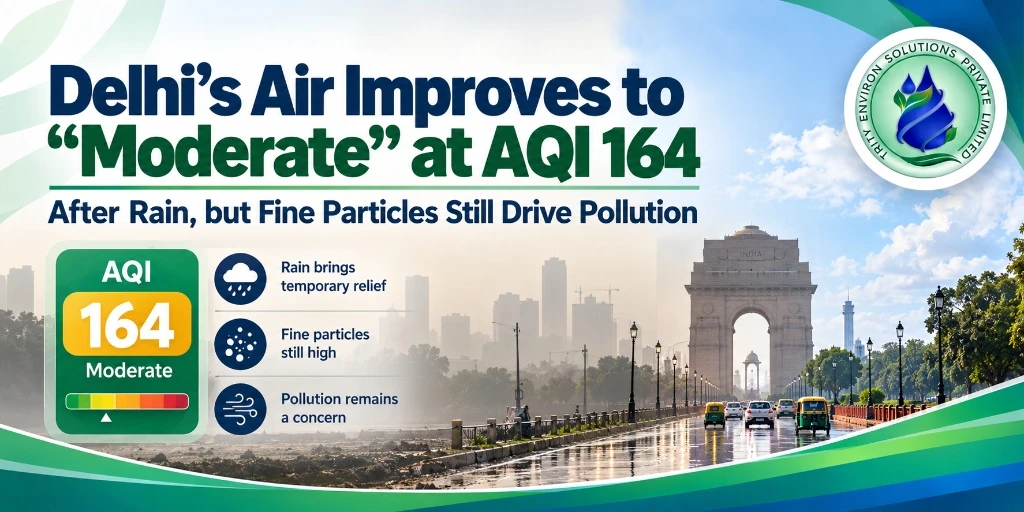
Delhi's Air Quality Index (AQI) stood at 164 at 7:05 am on Monday, October 26, in the "moderate" category, according to the CPCB's portal. Three days earlier, on Friday, October 23, it was 230, which is "poor".
The improvement followed a week of Stage I restrictions under the Graded Response Action Plan (GRAP), a government hotspot drive and overnight rain. The data also shows why the relief may be short-lived.
A Four-Day Timeline
Friday, October 23: poor at 230
- AQI of 230, in the "poor" category (The Pioneer, from CPCB's Sameer app)
- Of 56 stations, 3 were "very poor", 36 "poor" and 17 "moderate"
- Pusa had the highest reading, AQI 324
- Weather at Safdarjung: maximum 32.2°C, minimum 19°C
Saturday, October 24: 191, best in a decade for the date
- AQI of 191, "moderate"
- The Delhi government's Environment Department said it was the lowest for October 24 in a decade, excluding the Covid period. Earlier readings were 306 in 2024 and 275 in 2025
- Late Saturday night, rain with thunderstorms and strong winds hit Delhi, Noida, Ghaziabad, Gurugram and Faridabad, with hail in parts of Delhi and Noida
Sunday, October 25: 168 to 181, depending on the time and source
- India TV reported 181 at about 5 am. Inshorts reported 175 between 7 and 8 am
- Business Today and DNA reported an overall Delhi-NCR AQI of 168
- Business Standard later gave the CPCB daily reading for Sunday as 167
The figures differ because they come from different times and sources. They all sit in the "moderate" band.
Monday, October 26: 164
- AQI of 164 at 7:05 am, down 3 points from Sunday's CPCB daily reading of 167
- PM2.5 was the lead pollutant at 30 stations, and PM2.5 and PM10 were dominant overall
- 55 of 60 stations reported data
- Stations in the "poor" range: Vivek Vihar (235), R K Puram (223) and Narela (217)
How to Read the Categories
The CPCB bands relevant here are below. The moderate band and its health note are from Business Standard, and the Stage I range is from Business Today.
- 101 to 200 is "moderate", which can cause breathing discomfort for people with lung disorders, asthma or heart disease
- 201 to 300 is "poor", the band in which GRAP Stage I applies
- Above 300 is "very poor", the point at which stricter GRAP stages come in
A fall from 230 to 164 therefore moves Delhi out of the band where Stage I is triggered, but not into clean air. "Moderate" still carries a health note for sensitive groups. The 164 reading is a citywide figure at one moment in the morning, and individual stations ranged much higher.
What the Government Did
Environment Minister Manjinder Singh Sirsa credited enforcement, monitoring and public participation, and said the campaign would continue in "war mode". The statement, reported by PTI, gave figures for the previous 24 hours. These are government figures and have not been independently verified.
- About 9,883 vehicle challans issued
- 2,810 km of roads mechanically swept, and 1,075 km sprinkled with water
- 12,702 metric tonnes of waste removed
- 2,223 metric tonnes of construction and demolition (C&D) waste lifted
- 160 C&D sites or plots inspected
- 168 metric tonnes of road dust collected
An Integrated Command and Control Centre uses AI-enabled systems, CCTV and air quality monitoring to track sources.
The hotspot orders
On October 23, Sirsa asked officials to:
- Identify hotspots in southwest and west Delhi using AQI data and ground inspections
- Take time-bound action on road dust, congestion, encroachments and open waste burning
- Prepare hotspot-specific plans that name responsible agencies and deadlines
- Focus monitoring on PM10 and PM2.5 at vulnerable locations
Priority issues include road dust, heavy vehicle movement, construction and demolition, unauthorised parking and waste burning. Measures include removing encroachments, repairing potholes, treating exposed roadside soil and sprinkling water at dust-prone sites.
Where the Pollution Comes From
The Pioneer reported source shares from the IITM Pune Decision Support System on October 23. The report did not state which pollutant or measure the percentages refer to.
- Transport: 20.3%
- Stubble burning: 5.1%
- Residential: 5.2%
- Industries: 4.2%
- Construction: 2.6%
- Energy: 2%
- Waste burning: 1.8%
- Road dust: 1.4%
- Other sectors: 1.3%
- Other sources: 9.5%
Contributions from NCR areas: Gurugram 8.8%, Jhajjar 6.1% and Gautam Buddha Nagar 4.7%.
Reading the table carefully
- Transport leads by a wide margin
- Road dust's share appears small, even though the hotspot drive targets it. Shares from outside Delhi and from other sources make up a large part of the total, so a single day's table should not be over-read
- Stubble burning's share was 5.1% on October 23, and a forecast cited a day earlier had put Friday at 15.9%. A forecast and an estimate are different things
The Forecast Is Mixed
- The Air Quality Early Warning System expected "poor" air from October 23 to 26 and then unchanged for six more days, as reported by The Pioneer. It cited low ventilation, below 6,000 m²/s, and wind speed under 10 km/h
- India TV, on October 25, reported that the system expected "poor" from October 25 to 27, then fluctuating between poor and moderate for six days
- Inshorts reported that the AQI could climb to 317, which is "very poor"
The sources do not agree. The 317 figure is a forecast, and the others are broader category forecasts. Rain clears particles, but if winds stay light, they can build up again.
Why Rain Does Not Settle It
A September 30 analysis by the Centre for Science and Environment found Delhi had only one "good" air day during the 92-day 2026 monsoon, despite heavy rainfall. It linked this to high baseline emissions from vehicles, industry and waste burning, which rebuild quickly once the rain stops. CSE noted its findings show associations, not proof of cause.
What Facility Managers Should Do
Stage I has been in force since October 21. Facilities in the NCR should:
- Keep diesel generator sets for standby use only
- Damp and cover construction material, and keep dust screens in place
- Keep stack emissions within consent limits. Calibrated SOx NOx gas analysers let operators see deviations as they happen
- Keep monitoring records ready for inspections
What to Watch Next
- The next CPCB daily bulletins, to see whether 164 holds
- Whether the forecast "poor" period appears as the rain clears
- Whether the hotspot plans for southwest and west Delhi are published with deadlines
- Any move to GRAP Stage II if the AQI crosses 300