
Vermifiltration: Harnessing Natures Filters for Sustainable Wastewater Treatment
Discover how vermifiltration uses earthworms and microbes to treat wastewater naturally, offering a low-cost, eco-friendly alternative to traditional methods.

 ISO 9001:2015 & QCI Approved
Sewers and treatment plants quietly emit more greenhouse gas than most people realize, and at the same time, floods and rising seas are putting that same infrastructure at growing risk. Understanding both sides of this relationship is the first step to fixing it.

Speak directly with our senior environmental engineers for technical guidance, sizing calculations, or a tailored project proposal.
Call +91-9821030072 or email enquiry@trityenviro.com
Yes, directly. Treatment plants and sewers emit methane and nitrous oxide as byproducts of biological treatment processes, with global sewer systems alone estimated to emit 1.18-1.95 million tonnes of methane annually, and the sector overall contributing an estimated 1-5% of global greenhouse gas emissions.
Nitrous oxide is often the larger contributor to a plant's actual carbon footprint, potentially accounting for up to 75% of total emissions in some facilities, because it has a global warming potential roughly 265-298 times that of carbon dioxide, even though it's produced in smaller volumes than methane.
Increased rainfall intensity can overwhelm sewer and plant hydraulic capacity, causing overflows; rising sea levels threaten coastal plants with saltwater intrusion and flooding; and drought or rising temperatures can affect biological treatment performance and cause odour issues.
Yes. Capturing biogas from anaerobic digestion for on-site energy generation, optimizing aeration to reduce nitrous oxide formation, and integrating renewable energy sources are all proven strategies, with one study finding anaerobic digestion paired with cogeneration reduced global warming potential by 17% compared to landfill disposal.
Yes. Given documented increases in flooding, storm intensity, and sea level rise affecting treatment infrastructure globally, incorporating flood barriers, elevated critical equipment, and stormwater management into the initial design is far more cost-effective than retrofitting after a climate-related failure.
Discover how vermifiltration uses earthworms and microbes to treat wastewater naturally, offering a low-cost, eco-friendly alternative to traditional methods.
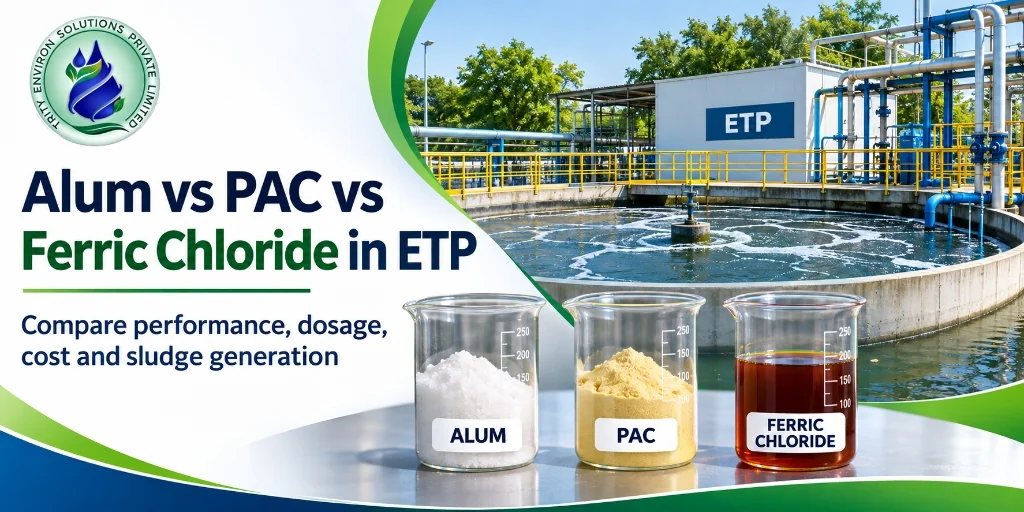
Trity Enviro compares alum, PAC and ferric chloride for ETP and STP: pH range, alkalinity use, sludge, cost, polymer choice and how to run a jar test.

Explore energy-efficient technologies that cut carbon emissions in wastewater treatment plants, using automation, renewables, and smart systems for sustainability.











Discuss your requirements with our engineering team and get practical guidance for your project.

