Table of Contents: Engineering Guide & Process Index
1. Regulatory Architecture of Common Effluent Treatment Plants (CETPs) in India
1.1 Mechanical Equipment Specifications and Component Sizing
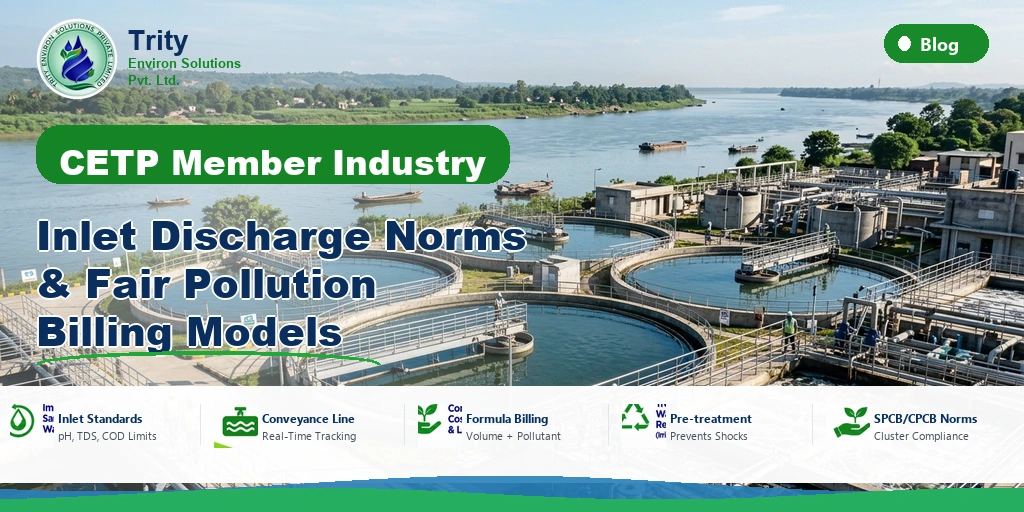
Common Effluent Treatment Plants (CETPs) serve as collective pollution abatement infrastructure for clusters of Small and Medium Enterprises (SMEs) that lack the capital, technical expertise, or physical land area required to construct and operate standalone zero-liquid-discharge (ZLD) or tertiary effluent treatment facilities. Under the Central Pollution Control Board (CPCB) and State Pollution Control Board (SPCB) framework, CETP societies are collectively responsible for achieving final discharge compliance (whether to inland surface waters, marine coastal outfalls, or 100% industrial water recycling).
1.2 Hydraulic Retention, Flow Distribution, and Peak Surge Management
However, the operational viability of a CETP depends entirely on enforcing strict pre-treatment standards at the boundary gate of every individual member manufacturing unit. If member industries discharge unauthorized toxic shock loads (such as heavy metals, extreme acidity, concentrated solvents, or toxic cyanides), the biological activated sludge in the central facility suffers irreversible mass mortality, resulting in immediate catastrophic compliance violations, National Green Tribunal (NGT) environmental compensation penalties, and potential regulatory closure orders across the entire industrial estate.
2. SPCB Pre-Treatment Standards: Individual Member Industry Inlet Limits
2.1 Statutory CPCB and SPCB Discharge Quality Standards
Every member unit operating within a CETP catchment zone must install an on-site primary effluent treatment plant (PETP) to reduce toxic parameters down to SPCB-mandated CETP acceptance limits before discharging into the conveyance network:
| Parameter |
Raw Industrial Effluent (Typical) |
Mandatory Member Inlet Limit |
Final CETP Discharge Standard |
| pH Value |
1.5 to 12.0 (Extreme swings) |
5.5 to 9.0 |
6.5 to 8.5 |
| Total Suspended Solids (TSS) |
800 to 4,500 mg/L |
< 300 to 400 mg/L |
< 30 to 50 mg/L |
| Chemical Oxygen Demand (COD) |
3,000 to 25,000 mg/L |
< 1,000 to 1,500 mg/L |
< 100 to 250 mg/L |
| Biochemical Oxygen Demand (BOD5) |
1,000 to 8,000 mg/L |
< 350 to 500 mg/L |
< 10 to 30 mg/L |
| Oil and Grease (FOG) |
150 to 800 mg/L |
< 20 mg/L |
< 10 mg/L |
| Total Dissolved Solids (TDS) |
5,000 to 45,000 mg/L |
< 2,100 mg/L (or segregated) |
< 2,100 mg/L (or ZLD recovery) |
| Total Chromium (Cr) |
15 to 120 mg/L |
< 2.0 mg/L |
< 0.5 mg/L |
| Phenolic Compounds |
25 to 250 mg/L |
< 5.0 mg/L |
< 1.0 mg/L |
2.2 Continuous Online Monitoring (OCEMS) and Compliance Audits
Member units generating high-TDS effluents (such as textile dyeing or chemical synthesis) must segregate their streams. High-TDS saline wastewater is conveyed via dedicated pipelines to specialized zero liquid discharge (ZLD) multi-effect evaporators, while low-TDS streams are routed to biological degradation units.
3. Wastewater Conveyance Engineering: Gravity Sewers vs Pressurized Dedicated Pipelines
3.1 Core Technology Comparison and Mechanistic Distinctions
Conveying industrial effluent from hundreds of member factories to a central CETP site presents formidable civil and environmental engineering challenges:
- Gravity Masonry / RCC Sewer Pipes: The historical method in older industrial estates, relying on underground concrete or stoneware pipes. This approach suffers from chronic vulnerabilities: biogenic sulfuric acid corrosion destroys the pipe crown within 7 to 10 years, toxic volatile solvent vapors accumulate in manholes (creating severe explosion risks for maintenance crews), and undetected exfiltration contaminates regional groundwater aquifers.
- Above-Ground or Trench-Mounted Pressurized HDPE/UPVC Pipelines: Modern CETP conveyance engineering mandates dedicated pressurized pipelines fabricated
3.2 Operational Efficiency, Footprint, and Capital Trade-offs
from High-Density Polyethylene (HDPE PE100, PN10 rating) or Glass-Reinforced Epoxy (GRE). Pipelines are laid inside concrete road utility trenches with removable precast covers, enabling 100% visual inspection, rapid leak detection, and total elimination of groundwater ingress or effluent exfiltration.
- Individual Pumping Stations with SCADA Telemetry: Each member factory operates an on-site final discharge chamber equipped with dual submersible pumps, an electromagnetic flow meter, and an automated motorized shut-off knife gate valve. If the CETP monitoring system detects parameter violations (e.g., pH < 5.5 or conductivity exceeding threshold), the CETP SCADA central server automatically closes the factory discharge valve, isolating the offending facility instantly.
4. Tariff and Billing Models: Two-Part and Three-Part Pollution Load Formulas
4.1 Mathematical Formulations and Governing Mass Balance
Equitable operational cost recovery is essential for the financial survival of a CETP. Historically, CETPs billed member units based purely on flat volumetric consumption (Rs. per kiloliter). This flawed methodology penalized clean, high-volume water users while providing a free ride to low-volume, ultra-concentrated chemical polluters who consumed 80% of the plant aeration energy and treatment chemicals.
4.2 Step-by-Step Numerical Sizing Protocol and Worked Example
Modern CETPs implement a Three-Part Tariff Pollution Load billing formula:
Three-Part Tariff Billing Formula:
Monthly Bill (Rs.) = C_fixed + (V_m * T_vol) + [M_COD * T_COD] + [M_TDS * T_TDS] + Penalty_Excess
Where:
- C_fixed = Fixed monthly membership charge (covers debt servicing, civil insurance, and fixed staffing)
- V_m = Total monthly effluent volume discharged (kL/month), measured by tamper-proof electromagnetic flow meter
- T_vol = Hydraulic conveyance and baseline treatment tariff (Rs. per kL)
- M_COD = Mass of Chemical Oxygen Demand discharged above baseline (kg COD/month) = [COD_actual, COD_base] * V_m / 1000
- T_COD = Aeration power and chemical oxidation surcharge tariff (Rs. per kg COD removed)
- M_TDS = Mass of Total Dissolved Solids discharged above baseline (kg TDS/month)
- T_TDS = Evaporation and brine crystallization tariff (Rs. per kg TDS treated)
- Penalty_Excess = Escalating punitive surcharge levied when inlet parameters exceed SPCB consent ceilings
5. Online Continuous Effluent Monitoring Systems (OCEMS) and Tamper-Proof Telemetry
5.1 Engineering Principles and System Configuration
To eliminate unauthorized nocturnal dumping, CPCB guidelines mandate the installation of Online Continuous Effluent Monitoring Systems (OCEMS) at the outlet of every member industry and the final CETP discharge:
- Core Sensor Instrumentation Array:
- Differential pH glass electrodes with automatic ultrasonic wash wipers
- Toroidal non-contact electrical conductivity sensors (for continuous TDS estimation)
- UV-Vis spectrophotometric sensors for continuous, reagentless COD and BOD monitoring (spectral absorption at 254 nm and 550 nm with turbidity compensation)
- Electromagnetic flow meter with bidirectional digital communication (RS-485 Modbus)
- Tamper-Proof Data Loggers and Cloud Connectivit
5.2 Operational Best Practices and Quality Control Benchmarks
y: Sensor data is acquired every 60 seconds by an IP65 data acquisition controller fitted with GPS geolocation, battery backup, and encrypted dual-SIM 4G cellular transmission. Data streams simultaneously to the CETP control room, State Pollution Control Board server, and CPCB central monitoring portal.
- Automated Mechanical Lock-Out Architecture: If any monitored parameter breaches the consent threshold for three consecutive 15-minute sampling intervals, the system trips an alarm, activates an audio-visual siren, and commands the motorized effluent shut-off valve to fail-safe close. Tampering with sensor wiring, power disconnection, or bypassing the flow meter generates an instant automated alert flag resulting in immediate physical inspection.
6. Standard Operating Procedure (SOP) for Member Unit Monitoring and Audit
6.1 Daily Start-Up, Inspection, and Operational Shift Protocol
A structured monitoring SOP enforces discipline across CETP member industries:
- Daily Automated SCADA Surveillance: CETP surveillance operators review 24-hour real-time flow and COD trend logs across all member nodes. Flag any sudden hydraulic peaks occurring during off-shift hours (22:00 to 05:00) or erratic conductivity spikes.
- Weekly Surprise Grab Sampling: The CETP mobile environmental task force conducts unannounced physical inspections of member factories. Collect split samples at the final discharge chamber, measuring pH, COD, TSS, oil and grease, and heavy metals in an NABL-accredited laboratory.
- Calibration Verification of On-Site OCEMS: Verify calibration of on-site pH and spectrophotometric sensors bi-weekly using certified seco
6.2 Preventive Maintenance, Instrument Calibration, and Safety Check
ndary standards. Inspect sensor flow cells for biofouling, scaling, or optical window scratching.
- Notice Issuance and Disconnection Protocol: If a member unit breaches inlet norms, issue a formal Tier-1 Warning Notice with a 48-hour rectification window. If a second consecutive breach occurs, immediately shut and seal the motorized discharge valve, report the non-compliance to the State Pollution Control Board, and levy the contractually mandated pollution load penalty.
- Annual Member Factory Mass Balance Audit: Audit raw material purchase records (chemicals, dyes, acids, salts), water utility meter readings, and finished product tonnage. Compute stoichiometric effluent generation yields to detect illegal borewell injection or off-site wastewater tanker dumping.
7. Field Troubleshooting Matrix: Resolving CETP Conveyance and Biological Shocks
7.1 Diagnostic Root-Cause Analysis for Common Process Upsets
When CETP performance is compromised, operators must rapidly isolate the industrial source using the following field diagnostic matrix:
7.2 Corrective Remediation Action Matrix and Operator Workflows
| Observed CETP Problem |
Probable Root Cause |
Diagnostic Field Test |
Engineering Corrective Action |
| Central aeration basin turns greyish-white; biological sludge deflocculates; DO drops to zero. |
Massive organic solvent or surfactant shock load dumped by member pharmaceutical or chemical factory. |
Review SCADA tributary log to trace COD surge to specific zone. Test inlet for volatile hydrocarbons. |
Divert inlet to emergency holding basin. Dose powdered activated carbon (PAC, 50 ppm) into aeration tank. Inoculate fresh bio-culture. |
| Biological nitrification ceases completely; treated effluent ammonia spikes > 50 mg/L. |
Heavy metal shock (copper, nickel, or chromium) poisoned autotrophic nitrifying bacteria. |
Screen CETP inlet composite sample via ICP-OES for heavy metals. Review electroplating member OCEMS. |
Isolate offending plating factory. Increase lime/sulfide dosing in primary clarifier to precipitate metals. Re-seed aeration tank. |
| Severe blockages in main gravity sewer network; manholes overflowing onto public roads. |
Solidification of emulsified fat, oil, grease (FOG) or wax discharged without temperature maintenance. |
Inspect manhole sediment. Extract hardened solid grease plugs and analyze melting point. |
Deploy high-pressure sewer jetting machine. Mandate installation of motorized DAF and oil skimmers at member factory outlets. |
| Reverse osmosis membranes at CETP ZLD plant foul irreversibly within 10 days of commissioning. |
Excessive refractory COD and reactive silica escaping primary treatment due to member overload. |
Analyze RO feed water for SDI, TOC, and colloidal silica. Autopsy fouled membrane element. |
Upgrade tertiary treatment with advanced oxidation (Fenton / Ozone) and ultrafiltration. Enforce member silica discharge limits. |
8. Lifecycle Financial Management, Special Purpose Vehicles (SPV) and NGT Compliance
8.1 Statutory CPCB and SPCB Discharge Quality Standards
Modern CETPs are structured as Special Purpose Vehicles (SPVs) governed under Public-Private Partnership (PPP) frameworks, registered under Section 8 of the Companies Act, 2013 as non-profit industrial consortiums. Operating a financially sustainable CETP requires disciplined capital budgeting:
- Capital Subsidies and Funding Architecture: Capital funding typically incorporates 50% grants from the Ministry of Environment, Forest and Climate Change (MoEFCC), 25% subsidies from State Industrial Development Corporations, and 25% equity contributed by member industrial associations.
- Sinking Fund and Capital Asset Replacement Reserve: Long-term equipment assets (diffusers, decanter centrifuges, high-pressure RO pumps, evaporator titanium heat exchanger tubes) degrade over 5 to 10 years. Successful SPVs allocate 15% of gross monthly operational collections into an escrowed Capital Replacement Reserve, eliminating the need to raise emergency capital calls from cash-strapped members when major mechanical overhauls occur.
- Legal Liability under Environmental Tribunal Rulings: Recent rulings from the National Green Tribunal (NGT) affirm the principle of joint and several liability. If a CETP breaches discharge norms, the SPCB is legally empowered to issue closure directions not only to the CETP management but directly to all individual member factories, cutting municipal water and electrical power supplies.
8.2 Continuous Online Monitoring (OCEMS) and Compliance Audits
By enforcing robust pre-treatment standards, continuous OCEMS surveillance, equitable three-part pollution billing, and transparent SPV governance, Common Effluent Treatment Plants achieve financial stability, environmental excellence, and enduring regional industrial prosperity.
9. Emergency Spill Management, Retention Lagoons and Zero Liquid Discharge (ZLD) Retrofit Strategies
9.1 Engineering Principles and System Configuration
Because industrial estates house diverse manufacturing facilities, accidental chemical spills (such as acid bath dumping, solvent tank leaks, or boiler blowdown rushes) represent an ever-present catastrophe hazard for CETPs. State Pollution Control Board guidelines mandate that every central facility construct a dedicated Emergency Containment and Equalization Buffer Lagoon designed to hold a minimum of 48 to 72 hours of total peak industrial inflow.
Modern CETP emergency management incorporates automated tributary diversion valves linked directly to regional catchment telemetry:
- Automated Divert Architecture: When the inlet telemetry station detects a sudden pH plunge below 4.0 or a TOC / conductivity spike exceeding 300% of baseline, the central PLC actuates automated penstock gates within 30 seconds. The toxic shock stream is diverted into an offline, HDPE-lined emergency holding basin, completely bypassing the biological activated sludge basins and protecting living biomass from toxic extermination.
- Gradual Bleed-Back and Controlled Neutralization: Once the emergency stream.
- Upgrading Conventional CETPs to Zero Liquid.
Strengthen Your CETP Operations and Member Compliance
9.2 Operational Best Practices and Quality Control Benchmarks
Implement tamper-proof OCEMS telemetry, three-part tariff billing, and robust pre-treatment standards with Trity Environ Solutions industrial wastewater consulting.
Get Expert Consultation
Call: +91 98188 14787
Related Technical Guides & Engineering Solutions
Explore our detailed engineering manuals and turnkey industrial plant solutions:
- Industrial Effluent Treatment Plant (Etp) Engineering: Industrial engineering, manufacturing, and turnkey compliance support.
- Zero Liquid Discharge (Zld) Plant Installations: Industrial engineering, manufacturing, and turnkey compliance support.
- Heavy-Duty Commercial Ro Plant Units: Industrial engineering, manufacturing, and turnkey compliance support.
- Customized Plant Design Consultation And Site Audits: Industrial engineering, manufacturing, and turnkey compliance support.
- Chemical Precipitation in Industrial ETP: Coagulant and Flocculant Dosing Optimization Guide
- Tannery Effluent Treatment: Chromium Recovery, Sulfide Stripping and ZLD Engineering Guide
- Pulp and Paper Mill ETP: Lignin Removal, Colour Reduction and Fiber Recovery Engineering Guide
- RO Reject Brine Concentration: High Recovery RO vs EDR for Zero Liquid Discharge (ZLD) Guide
For turnkey plant sizing, technical audits, or statutory pollution control board compliance, contact our senior process specialists for on-site environmental engineering consultation.