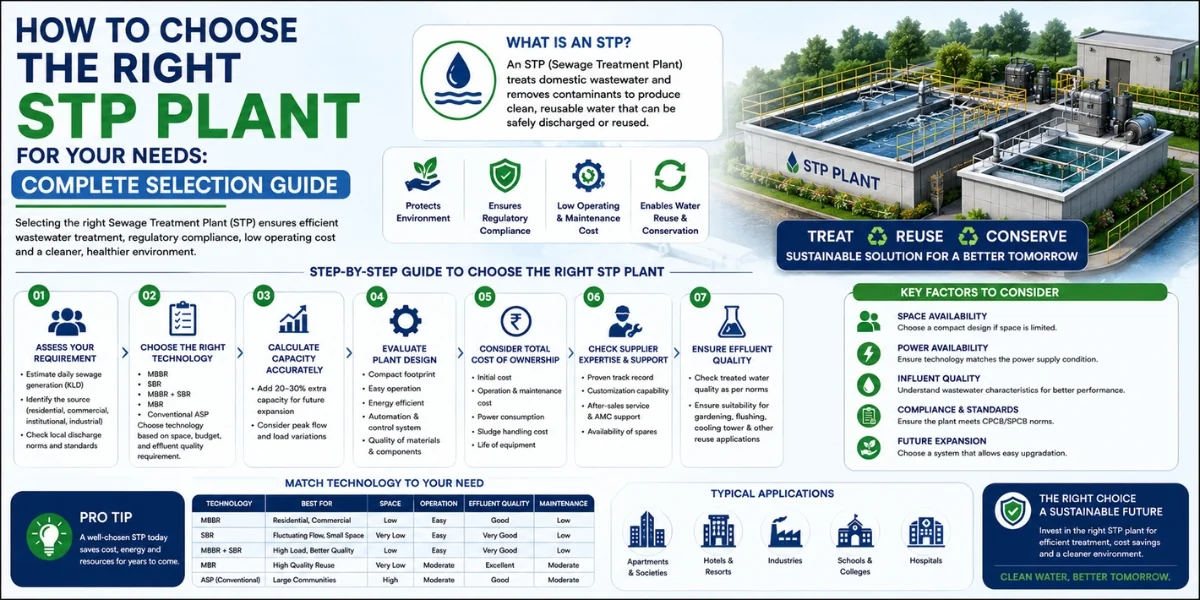
How to Choose the Right STP Plant for Your Needs: Complete Selection Guide
Compare STP plant types, capacity sizing, technology options, and cost factors to choose the right sewage treatment plant for your property.

 ISO 9001:2015 & QCI Approved
A comprehensive engineering guide to identifying sewage odour causes, designing bio-scrubbers and activated carbon systems, and achieving odour-free STP operation in residential and commercial buildings.
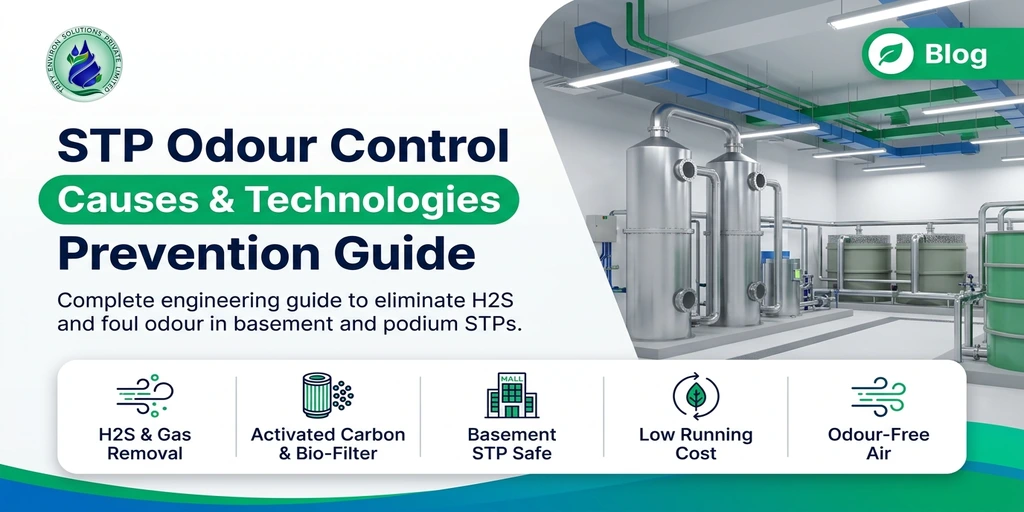
Sewage treatment plants in modern residential complexes, commercial IT parks, hospitals, and shopping malls are frequently located in basements or podium levels. While underground installation saves valuable ground-level real estate, it introduces a severe operational challenge: the containment and treatment of foul odours.
When sewage undergoes septic decomposition due to stagnation, inadequate aeration, or pump station delays, anaerobic bacteria reduce sulfates into hydrogen sulfide (H2S), mercaptans, amines, and volatile organic compounds (VOCs). Beyond causing severe resident and tenant complaints, H2S gas is highly toxic and reacts with moisture to form sulfuric acid (H2SO4), causing severe biogenic corrosion to concrete walls, electrical panels, ducting, and piping.
A properly engineered STP odour control system prevents foul gases from escaping into parking areas, lift lobbies, and ventilation shafts, ensuring a safe, compliant, and complaint-free environment. This guide provides a detailed engineering overview of sewage odour generation, compares the leading treatment technologies, and outlines proven operational strategies to maintain an odourless STP.
Raw sewage entering the collection sump carries significant organic loads (BOD and COD). If wastewater sits in collection chambers or equalisation tanks without adequate dissolved oxygen (DO < 0.5 mg/L), anaerobic bacteria thrive. In the absence of oxygen, these microbes break down organic sulfur compounds and sulfates, releasing H2S gas. Peak morning and evening discharge swings frequently leave sewage standing for hours, accelerating septic conditions.
Excess sludge wasted from secondary clarifiers, MBBR tanks, or MBR membrane basins continues biological activity. When stored in sludge holding tanks without gentle aeration or mixing, sludge rapidly goes anaerobic. During mechanical dewatering via filter presses, centrifuges, or screw presses, the agitation and exposure of wet sludge cake release concentrated surges of ammonia, dimethyl sulfide, and mercaptans into the room air.
Even well-operated tanks emit trace amounts of volatile compounds. In an enclosed basement, odour issues intensify if the room ventilation is undersized. Effective odour containment requires continuous exhaust ventilation designed for 12 to 15 air changes per hour (ACH) under slight negative pressure (-15 to -25 Pa). Negative pressure ensures air flows into the STP room from corridors, preventing contaminated air from leaking into common areas.
Activated carbon systems draw foul air through beds of virgin or chemically impregnated granular activated carbon (GAC). Impregnated carbons (such as potassium hydroxide or catalytic carbons) convert H2S into elemental sulfur or sulfate salts. * Advantages: High removal efficiency (>99% for H2S and VOCs), compact footprint, no liquid chemical handling, excellent for variable and low-to-medium flow rates. * Limitations: Media requires replacement once saturated (typically every 12 to 24 months depending on inlet H2S concentration); high humidity (>80% RH) can blind pores if not pre-conditioned.
Biological scrubbers pass foul exhaust air through an engineered synthetic or lava-rock media bed that is continuously recirculated with nutrient-rich water. Microorganisms (primarily Thiobacillus species) colonise the media and oxidise H2S into harmless sulfate ions: $$\text{H}_2\text{S} + 2\text{O}_2 \xrightarrow{\text{Bacteria}} \text{H}_2\text{SO}_4$$ * Advantages: Very low ongoing chemical cost, sustainable green technology, ideal for high continuous H2S concentrations (>20-100 ppm). * Limitations: Requires consistent moisture, biological acclimation time, and larger physical footprint than pure carbon adsorption units.
Chemical scrubbers treat foul air by contacting it with chemical scrubbing solutions (typically sodium hypochlorite NaOCl and caustic soda NaOH) in packed towers. * Advantages: Handles very high air volumes and fluctuating high inlet concentrations with fast reaction kinetics. * Limitations: High operational expenditure for chemicals, requires chemical storage tanks and safety bunds, and produces spent chemical bleed that must be routed back into the ETP/STP.
| Parameter | Activated Carbon Adsorber | Bio-Trickling Scrubber | Chemical Wet Scrubber |
|---|---|---|---|
| Primary Mechanism | Physical / Catalytic Adsorption | Biological Microbial Oxidation | Gas-Liquid Chemical Reaction |
| H2S Removal Efficiency | >99.5% (fresh media) | >95% - 98% | >98% - 99% |
| VOC & Mercaptan Removal | Excellent (Broad Spectrum) | Moderate to Good | Good (Oxidising Stage) |
| Chemical Handling Required | None (Dry System) | None (Water/Nutrient only) | High (NaOH, NaOCl dosing) |
| Footprint Required | Very Compact | Moderate | Moderate to Large |
| Ideal Application | Basement STPs, Hotels, Malls | Townships, Municipal STPs | Large Industrial CETPs/STPs |
Directly capturing foul air at the source is ten times more efficient than ventilating an entire room. Fit equalisation tanks, grit chambers, and sludge sumps with heavy-duty FRP or aluminum gastight covers equipped with airtight inspection hatches. Route extraction ducting directly from under the tank covers to the odour treatment scrubber.
Prevent septic conditions upstream before odours form. Install pre-aeration coarse bubble diffusers or submersible aerator-mixers in the raw sewage equalisation tank to maintain a minimum dissolved oxygen (DO) level of 1.0 to 1.5 mg/L. Aeration inhibits anaerobic sulfate-reducing bacteria and prevents H2S generation.
In long sewer collection lines or large holding basins with extended retention times, dosing iron salts (ferric chloride) or calcium nitrate into raw sewage precipitates dissolved sulfides as insoluble iron sulfide (FeS) or provides an alternative electron acceptor, stopping H2S gas release entirely.
Trity Environ Solutions designs, manufactures, and integrates custom STP odour control systems tailored for residential societies, commercial complexes, and municipal plants across India.
Speak directly with our senior environmental engineers for technical guidance, sizing calculations, or a tailored project proposal.
Call +91-9821030072 or email enquiry@trityenviro.com
Compare STP plant types, capacity sizing, technology options, and cost factors to choose the right sewage treatment plant for your property.
A practical checklist for bulk waste generators under SWM Rules 2026: registration, four-stream segregation, on-site processing, EBWGR certificates and records.

How ETPs and STPs conserve water, energy, and nutrients in India, with real recovery data, and the large untapped potential still being missed.











Discuss your requirements with our engineering team and get practical guidance for your project.

