Challenges of Treating High-Salinity Effluents in Coastal ETPs
Explore key challenges and advanced solutions for treating high-salinity wastewater in coastal effluent treatment plants (ETPs) and industrial regions.

 ISO 9001:2015 & QCI Approved
A definitive engineering guide to electroplating wastewater treatment, detailing stream segregation, alkaline chlorination of cyanides, chrome reduction, and heavy metal precipitation for strict PCB compliance.
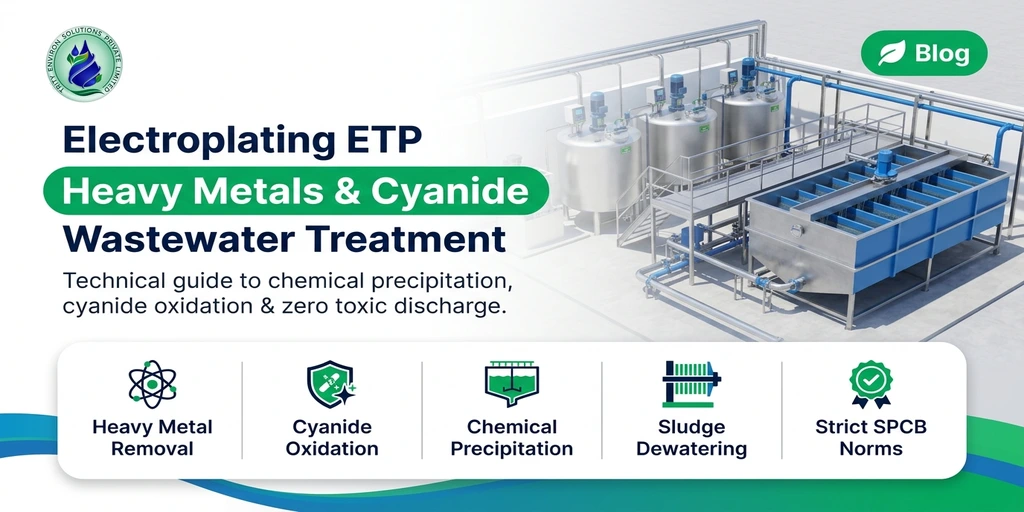
The electroplating, anodising, and metal surface finishing industry is among the most environmentally sensitive industrial sectors in India. Metal finishing operations—ranging from automotive component plating and hardware galvanising to aerospace nickel-chrome coating—produce rinse waters and spent process baths contaminated with toxic pollutants.
These wastewater streams contain hazardous heavy metals including copper (Cu), nickel (Ni), zinc (Zn), cadmium (Cd), and lead (Pb), alongside hexavalent chromium (Cr6+) and highly toxic free and complexed cyanides (CN-). Furthermore, strong acids, alkaline degreasers, and high total dissolved solids (TDS) present severe environmental risks.
Discharging untreated or poorly treated electroplating effluent directly into municipal drains or water bodies violates Central Pollution Control Board (CPCB) and State Pollution Control Board (SPCB) guidelines, triggering severe legal penalties and closure orders. A high-performance electroplating effluent treatment plant (ETP) employs stream segregation, precision chemical oxidation-reduction, and chemical precipitation to safely eliminate toxicity and enable water recovery.
The most common failure in metal finishing ETP design is mixing distinct process rinses in a single collection pit. Mixing cyanide rinses with acidic or chrome rinses is catastrophic: acidic conditions liberate deadly hydrogen cyanide (HCN) gas, while mixed metal complexes resist chemical precipitation. An effective electroplating ETP strictly segregates effluent at the source into four dedicated streams:
Cyanide oxidation requires a rigorous, automated two-stage alkaline chlorination process using sodium hypochlorite (NaOCl) or chlorine gas: * Stage 1 (Cyanate Formation): At a strictly controlled alkaline pH of 10.5 to 11.0 (adjusted via NaOH) and an ORP of +350 to +400 mV, free cyanide is rapidly converted to cyanate: $$\text{NaCN} + \text{NaOCl} \rightarrow \text{NaCNO} + \text{NaCl}$$ Maintaining pH > 10.5 is vital to prevent the formation of volatile and lethal cyanogen chloride (CNCl) gas. * Stage 2 (Complete Destruction to Nitrogen and Carbon Dioxide): The pH is lowered to 8.0 - 8.5 via acid, and additional NaOCl is dosed at an ORP of +600 to +650 mV to oxidise cyanate into harmless nitrogen gas and bicarbonate: $$2\text{NaCNO} + 3\text{NaOCl} + \text{H}_2\text{O} \rightarrow \text{N}_2 \uparrow + 2\text{NaHCO}_3 + 3\text{NaCl}$$
Hexavalent chromium (Cr6+) is carcinogenic, highly soluble, and cannot be precipitated directly. It must first be reduced to trivalent chromium (Cr3+): * The acidic chromium stream is conditioned to pH 2.0 - 2.5 using sulfuric acid (H2SO4). * A reducing agent—typically sodium metabisulfite (SMBS, Na2S2O5) or ferrous sulfate (FeSO4)—is added under automated ORP control (+250 to +300 mV): $$2\text{H}_2\text{CrO}_4 + 3\text{Na}_2\text{S}_2\text{O}_5 + 3\text{H}_2\text{SO}_4 \rightarrow \text{Cr}_2(\text{SO}_4)_3 + 3\text{Na}_2\text{SO}_4 + 5\text{H}_2\text{O}$$ Once reduced to trivalent chromium (Cr3+), the wastewater is transferred to the heavy metal neutralization tank.
The de-cyanided stream, reduced chrome stream, and general acid-alkali streams merge in the neutralization and precipitation tank. * Hydrated lime (Ca(OH)2) or caustic soda (NaOH) is dosed to elevate pH to the optimal precipitation window for multi-metal systems (typically pH 8.8 to 9.5). * Dissolved heavy metals convert into insoluble metal hydroxides: $$\text{M}^{2+} + 2\text{OH}^- \rightarrow \text{M(OH)}_2 \downarrow$$ * Coagulant (PAC) and anionic polyelectrolyte are dosed in a flocculation chamber to agglomerate fine pin-flocs into heavy, fast-settling flocs. * The slurry enters a high-rate Lamella Tube Settler or clarifier, where clear supernatant overflows to filtration, while dense sludge settles to the bottom cone.
| Parameter | Raw Untreated Effluent | After Chemical ETP | CPCB / SPCB Discharge Standard |
|---|---|---|---|
| pH | 1.5 - 3.5 (Acidic) | 7.5 - 8.5 | 6.5 - 9.0 |
| Total Cyanide (CN) | 10 - 150 mg/L | < 0.1 mg/L | 0.2 mg/L |
| Hexavalent Chromium (Cr6+) | 20 - 200 mg/L | < 0.05 mg/L | 0.1 mg/L |
| Total Chromium (Cr) | 50 - 350 mg/L | < 0.8 mg/L | 2.0 mg/L |
| Nickel (Ni) | 15 - 120 mg/L | < 1.0 mg/L | 3.0 mg/L |
| Zinc (Zn) | 30 - 250 mg/L | < 1.5 mg/L | 5.0 mg/L |
| Total Suspended Solids (TSS) | 150 - 800 mg/L | < 20 mg/L | 100 mg/L |
Electroplating sludge contains high concentrations of hazardous heavy metal hydroxides and is classified as Schedule I Hazardous Waste under the Hazardous and Other Wastes Rules, 2016. Settled sludge from the clarifier must be dewatered using a high-pressure Recessed Plate Filter Press to achieve a dry cake (>35% solids) before authorized handover to a Common Hazardous Waste Treatment, Storage, and Disposal Facility (TSDF).
For facilities located in notified industrial clusters or zero discharge zones, the clarified ETP treated water is passed through Multi-Grade Sand Filters (MGF), Activated Carbon Filters (ACF), and Ultrafiltration (UF), followed by a high-recovery Industrial Reverse Osmosis (RO) and Multi-Effect Evaporator (MEE) to achieve complete 100% Zero Liquid Discharge.
Trity Environ Solutions is an established leader in industrial wastewater engineering, delivering robust, fully automated electroplating ETP plants across India.
Speak directly with our senior environmental engineers for technical guidance, sizing calculations, or a tailored project proposal.
Call +91-9821030072 or email enquiry@trityenviro.com
Explore key challenges and advanced solutions for treating high-salinity wastewater in coastal effluent treatment plants (ETPs) and industrial regions.
How Legionella bacteria establish in wastewater treatment plants, the real occupational risk, and the control methods that actually work.
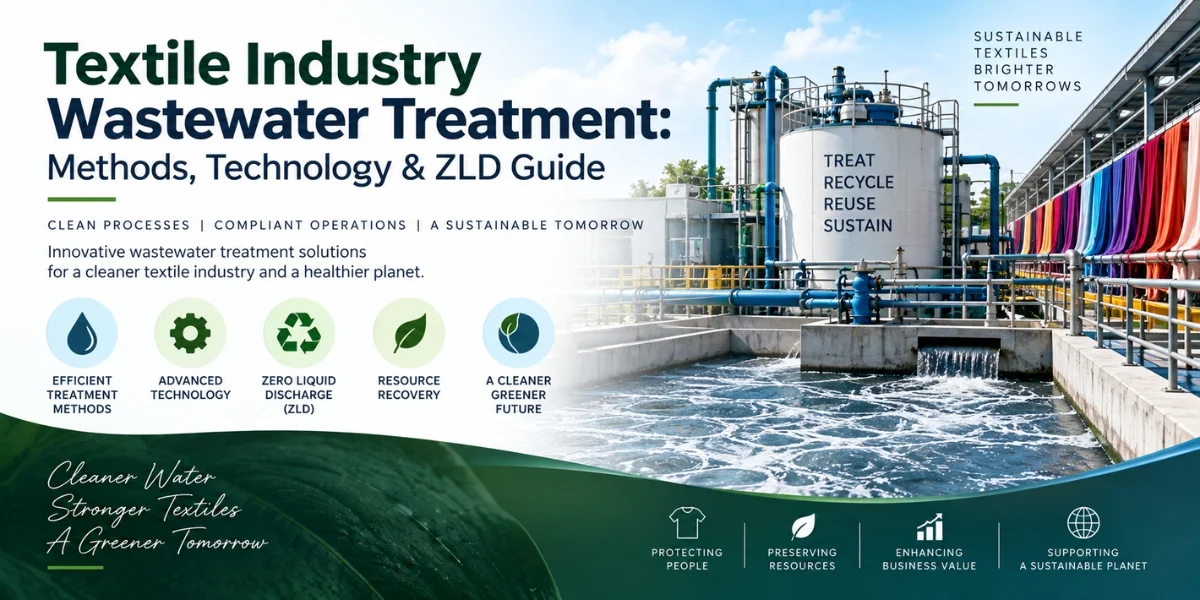
A complete guide to textile wastewater treatment methods, physical, biological, and advanced, from a trusted ETP manufacturer in India.











Discuss your requirements with our engineering team and get practical guidance for your project.

