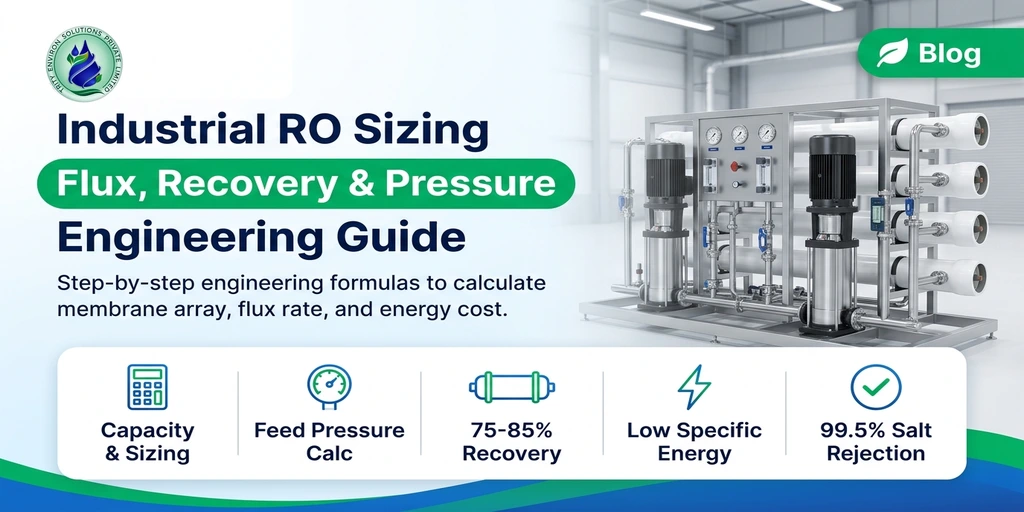
Industrial RO Sizing Guide: Calculating Feed Pressure, Flux and Recovery
Master industrial RO sizing calculations: membrane array design, permeate flux (GFD), osmotic pressure, pump power sizing, and recovery limits.

 ISO 9001:2015 & QCI Approved
A technical manual for dairy effluent treatment, detailing primary fat-oil-grease separation via DAF, anaerobic biogas recovery, extended aeration, and compliance with CPCB norms.
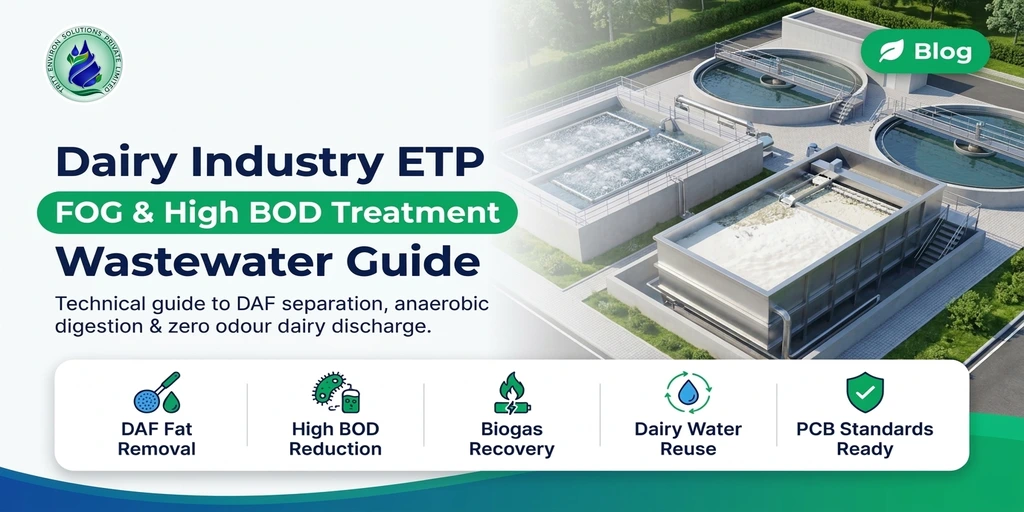
The dairy processing industry in India—spanning milk collection, pasteurization, butter, ghee, cheese, and milk powder production—consumes between 1.5 to 3.0 liters of water for every liter of milk processed. The resulting wastewater carries high concentrations of milk fat, proteins (casein), sugars (lactose), and Clean-In-Place (CIP) cleaning chemicals such as caustic soda and nitric acid.
Dairy wastewater exhibits extreme fluctuations in flow and organic concentration. Biochemical Oxygen Demand (BOD) frequently ranges between 1,500 to 4,000 mg/L, with Chemical Oxygen Demand (COD) spiking up to 3,000 to 7,000 mg/L. Unseparated milk fats and grease coat pipes, blind diffusers, and form thick floating scum blankets that turn septic rapidly, generating foul rancid butter odours (butyric acid).
A high-efficiency Dairy Effluent Treatment Plant (ETP) integrates mechanical screening, Dissolved Air Flotation (DAF) for fat separation, high-rate anaerobic digestion, and biological aeration to ensure compliant discharge and enable factory water recycling.
Conventional gravity grease traps are inefficient for emulsified milk fats. A high-rate Dissolved Air Flotation (DAF) system is the gold standard in dairy ETP design: * Microscopic air bubbles (20 to 50 microns) are generated by saturating recycled water with compressed air at 4 to 6 bar pressure. * Coagulants (alum or PAC) and polymers are dosed in an inline pipe flocculator to destabilize milk fat emulsions. * The micro-bubbles attach to fat globules, floating them rapidly to the liquid surface where mechanical scrapers continuously remove dense fat float. * Performance: DAF removes 80% to 95% of Fat, Oil & Grease and reduces 30% to 40% of inlet COD upstream of biological tanks.
Dairy processing cycles cause dramatic pH swings: acidic rinses during sanitization (pH 3.0 - 4.5) alternate with alkaline caustic washing (pH 10.5 - 12.0). An equalisation tank designed for 10 to 14 hours retention with an automated pH neutralization loop (dosing HCl/H2SO4 and NaOH) is essential to provide a stable pH (6.8 to 7.8) to downstream biology.
For medium-to-large dairy plants (>100 KLD) with COD > 3,000 mg/L, anaerobic treatment via an Upflow Anaerobic Sludge Blanket (UASB) reactor is highly cost-effective: * Anaerobic granular sludge digests biodegradable milk sugars and proteins without requiring high-power aerators. * Converts over 75% to 85% of COD into valuable biogas (methane ~65-70%), which can be combusted in boilers to offset factory fuel costs. * Produces substantially less biological sludge compared to purely aerobic systems.
Effluent exiting the UASB or DAF unit enters an aerobic biological treatment stage (Extended Aeration Activated Sludge or MBBR) to polish remaining BOD to below CPCB limits (<30 mg/L): * Fine bubble membrane diffusers maintain dissolved oxygen (DO) at 2.0 to 3.0 mg/L. * Complete nitrification oxidizes milk protein nitrogen into nitrates, preventing toxic ammonia discharge.
| Parameter | Raw Dairy Effluent | After DAF Treatment | After Biological ETP | CPCB Discharge Norms |
|---|---|---|---|---|
| pH | 4.0 - 10.5 | 6.8 - 7.5 | 7.2 - 7.8 | 6.5 - 8.5 |
| Biochemical Oxygen Demand (BOD5) | 1,500 - 3,500 mg/L | 800 - 1,800 mg/L | < 20 mg/L | 30 mg/L (100 for irrigation) |
| Chemical Oxygen Demand (COD) | 3,000 - 6,500 mg/L | 1,500 - 3,500 mg/L | < 150 mg/L | 250 mg/L |
| Total Suspended Solids (TSS) | 600 - 1,800 mg/L | 150 - 300 mg/L | < 30 mg/L | 100 mg/L |
| Oil & Grease (FOG) | 250 - 800 mg/L | < 25 mg/L | < 5 mg/L | 10 mg/L |
| Total Dissolved Solids (TDS) | 1,200 - 2,500 mg/L | 1,200 - 2,500 mg/L | 1,100 - 2,200 mg/L | 2,100 mg/L |
Trity Environ Solutions specializes in turnkey dairy ETP design, delivering energy-efficient, robust plants for milk cooperatives, cheese processors, and ice-cream manufacturers across India.
Speak directly with our senior environmental engineers for technical guidance, sizing calculations, or a tailored project proposal.
Call +91-9821030072 or email enquiry@trityenviro.com
Master industrial RO sizing calculations: membrane array design, permeate flux (GFD), osmotic pressure, pump power sizing, and recovery limits.
In late 2025, contaminated municipal water in Indore killed dozens of people. Here's what actually goes into water purification, the real health and industrial stakes, and how Trity Environ Solutions builds systems that address them.
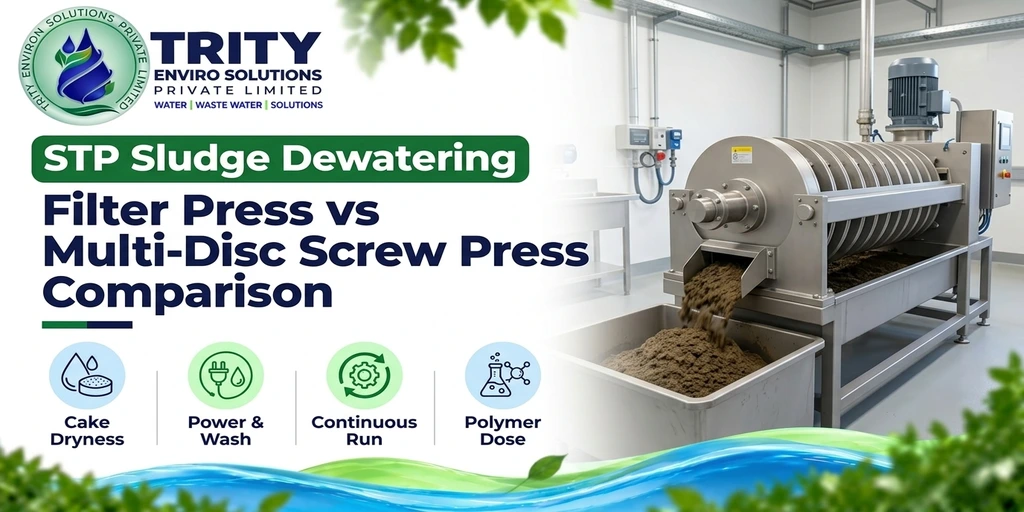
Compare filter press, screw press, belt press, centrifuge and drying beds for STP sludge. See cake dryness, polymer use, space and cost to choose well.











Discuss your requirements with our engineering team and get practical guidance for your project.

