TRITY ENVIRO
WATER • WASTEWATER • RECYCLING

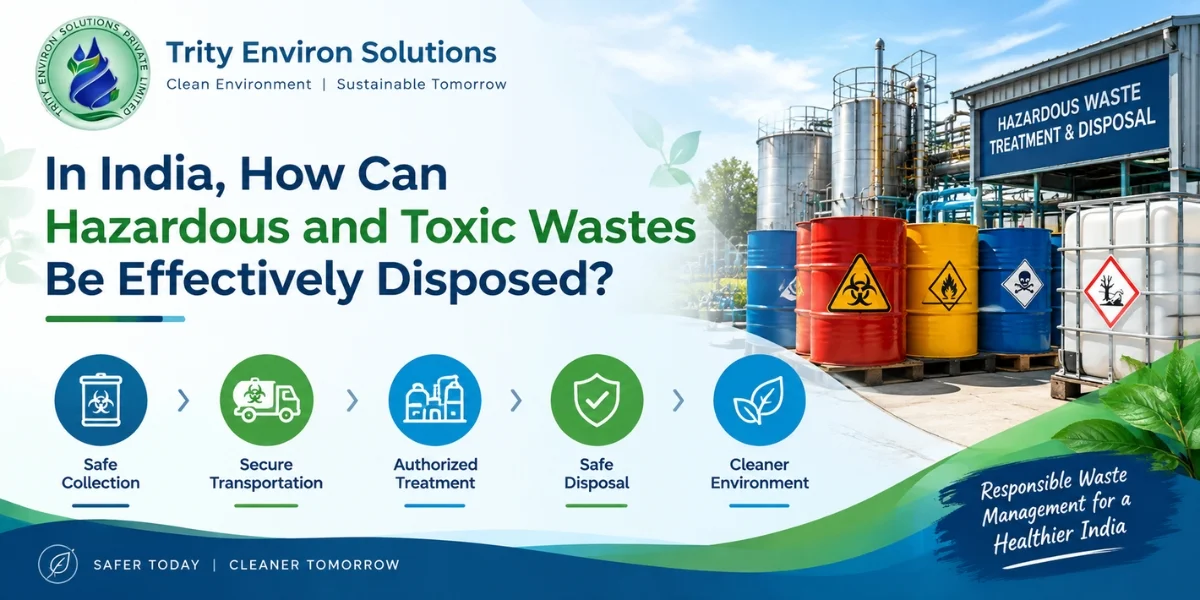
In India, How Can Hazardous and Toxic Wastes Be Effectively Disposed?

India generates over 7.4 million metric tonnes of hazardous waste every year, and how that waste is classified, stored, and disposed of is governed by a specific legal framework, not general judgment. This guide covers exactly how the system works.

In India, How Can Hazardous and Toxic Wastes Be Effectively Disposed?

The Scale of India's Hazardous Waste Challenge

Engineering Consultation

Looking to Sizing or Upgrading Your Treatment Plant?

Speak directly with our senior environmental engineers for technical guidance, sizing calculations, or a tailored project proposal.
Call +91-9821030072 or email enquiry@trityenviro.com

Request Free Engineering Consultation
Request a Free Site Assessment
Previous Article Next Article
TECHNICAL QUESTIONS

Frequently Asked Questions

The Hazardous and Other Wastes (Management and Transboundary Movement) Rules, 2016, notified under the Environment (Protection) Act, 1986, govern the generation, storage, transportation, treatment, and disposal of hazardous waste across India, and give domestic effect to the Basel Convention.
Generally, hazardous waste cannot be stored beyond 90 days without a specific extension approved by the relevant State Pollution Control Board, making timely disposal planning an essential part of compliance.
A Treatment, Storage and Disposal Facility (TSDF) is an authorized site for managing hazardous waste, either built and operated by an individual industry (captive) or shared across multiple industries (common). Roughly 40 common TSDFs currently operate across 17 Indian states, offering a compliant disposal route for facilities without their own dedicated infrastructure.
The Rules establish a clear hierarchy: prevention and minimization at source first, followed by reuse, recycling, and recovery, then co-processing as energy recovery, with final disposal through a TSDF or secure landfill reserved as the last resort.
Yes, used oil and spent lubricants are explicitly classified as hazardous waste under Indian regulations and must be collected and disposed of through authorized recyclers rather than mixed with general effluent or waste streams.
KEEP READING

Related Technical Articles

View All Articles →
PROVEN EXPERIENCE

Featured Turnkey Installations

Need Expert Support for Your Water Treatment Project?

Discuss your requirements with our engineering team and get practical guidance for your project.

QCI Approved
seller
whatsapp-image