Introduction: The Role of Aeration in Biological Sewage Treatment
In aerobic biological wastewater treatment—whether conventional activated sludge, MBBR, SBR, or MBR—the aeration blower is the single most critical mechanical asset. Aerobic heterotrophic bacteria require continuous dissolved oxygen (DO) to oxidize biodegradable organic matter (BOD/COD) into carbon dioxide and water, while autotrophic bacteria require oxygen to nitrify toxic ammonia into nitrates.
Aeration is also the largest energy consumer in any wastewater facility, accounting for 50% to 75% of total plant electricity consumption. An undersized blower starves the biomass, leading to septic odours, black sludge, and violation of CPCB discharge norms. An oversized blower wastes thousands of kilowatt-hours of electricity, shears biological flocs, and over-aerates equalisation basins.
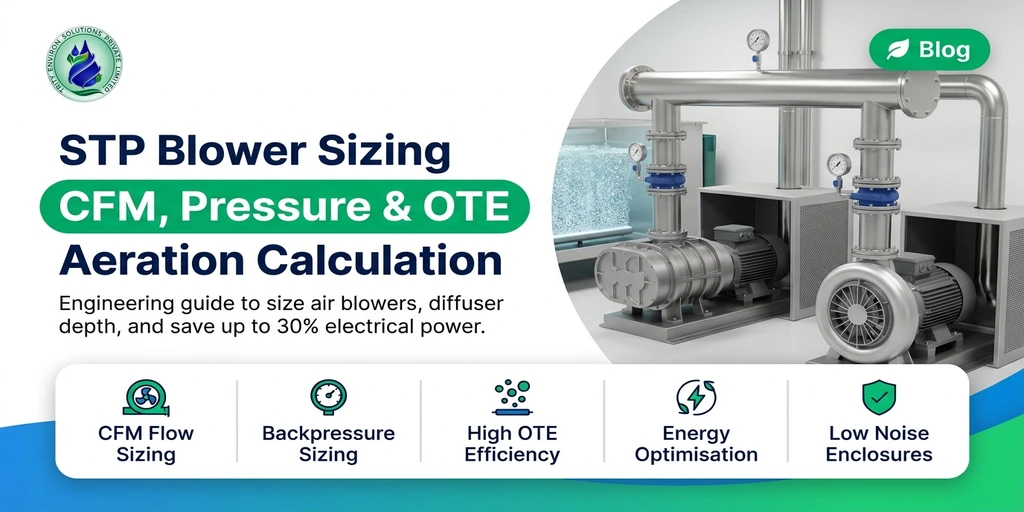
Proper blower sizing requires calculating biological oxygen demand, adjusting for site environmental factors, evaluating diffuser Oxygen Transfer Efficiency (OTE), and calculating total static and dynamic head.
Biological Oxygen Demand Calculations (AOR and SOR)
1. Actual Oxygen Requirement (AOR)
The biological process requires oxygen for carbonaceous BOD removal and nitrogenous nitrification:
$$\text{AOR (kg O}_2/\text{day)} = (a \times \Delta\text{BOD}) + (b \times \Delta\text{NH}_4\text{-N}) - (c \times \text{NO}_3\text{ denitrified})$$
* Carbonaceous Demand: Typically $1.0\text{ to }1.2\text{ kg O}_2$ per kg BOD removed.
* Nitrification Demand: Stoichiometrically requires $4.57\text{ kg O}_2$ per kg of Ammoniacal Nitrogen (NH4-N) oxidized into nitrate (NO3).
* Worked Example (100 KLD STP):
- Daily BOD removed: $100\text{ m}^3 \times (0.30 - 0.01\text{ kg/m}^3) = 29\text{ kg BOD/day}$. Oxygen needed = $29 \times 1.1 = 31.9\text{ kg O}_2$.
- Daily TKN removed: $100\text{ m}^3 \times (0.040 - 0.005\text{ kg/m}^3) = 3.5\text{ kg N/day}$. Oxygen needed = $3.5 \times 4.57 = 16.0\text{ kg O}_2$.
- Total $\text{AOR} = 31.9 + 16.0 = 47.9\text{ kg O}_2/\text{day}$ (approx. $2.0\text{ kg O}_2/\text{hr}$).
2. Converting AOR to Standard Oxygen Requirement (SOR)
Actual oxygen transfer depends on water temperature, altitude, dissolved oxygen deficit, and wastewater salinity/surfactants (alpha and beta factors):
$$\text{SOR} = \text{AOR} \times \left[ \frac{C_{s,20}}{\alpha \times (\beta \times C_{s,T,H} - C_L) \times \theta^{T-20}} \right]$$
In typical Indian municipal sewage with fine bubble diffusers, the correction ratio $(\text{SOR} / \text{AOR})$ ranges from 1.6 to 2.2. For our worked example: $\text{SOR} = 2.0 \times 1.8 = 3.6\text{ kg O}_2/\text{hr}$.
Diffuser Oxygen Transfer Efficiency and Airflow (CFM)
Calculating Standard Airflow (SCFM and m3/hr)
Air contains approximately 23.2% oxygen by weight, with standard air density of $1.204\text{ kg/m}^3$ ($0.279\text{ kg O}_2$ per m3 of air).
Fine bubble EPDM membrane disc diffusers installed at $4.0\text{ m}$ liquid depth typically achieve a Standard Oxygen Transfer Efficiency (SOTE) of $6.0\%\text{ per metre depth} \implies \text{SOTE} = 24\%$.
$$\text{Airflow } (Q_{\text{air}}) = \frac{\text{SOR (kg O}_2/\text{hr})}{\text{Air Density} \times 0.232 \times \text{SOTE}} = \frac{3.6}{1.204 \times 0.232 \times 0.24} \approx 53.7\text{ m}^3/\text{hr} \approx 32\text{ CFM}$$
Applying a standard $20\%$ engineering safety margin and accounting for mixing air requirements, the blower is sized for 40 to 45 CFM.
Minimum Mixing Air Criteria
In activated sludge and MBBR systems, aeration must satisfy both biological oxygen demand and physical mixing to keep biomass and media in suspension. Fine bubble aeration requires a minimum mixing rate of $1.8\text{ to }2.4\text{ m}^3/\text{hr per m}^2$ of tank floor area, or $20\text{ to }30\text{ m}^3\text{ air per }1,000\text{ m}^3\text{ tank volume per minute}$.
Calculating Total Blower Discharge Pressure
A blower does not generate pressure; it overcomes system backpressure. Total discharge pressure is the sum of four resistance components:
1. Liquid Static Head: Height of water column above diffusers. For a $4.0\text{ m}$ liquid depth $\implies 0.40\text{ bar}$ ($4,000\text{ mmWC}$).
2. Diffuser Orifice / Membrane Resistance: Friction loss across EPDM micro-slits $\implies 0.03\text{ to }0.05\text{ bar}$ ($300 - 500\text{ mmWC}$).
3. Piping and Valve Friction: Air header pipes, elbows, flow control valves, and non-return valves $\implies 0.02\text{ to }0.04\text{ bar}$.
4. Air Inlet Filter Loss: Intake filter fouling allowance $\implies 0.01\text{ bar}$.
Total Discharge Pressure: $0.40 + 0.04 + 0.03 + 0.01 = 0.48\text{ bar}$ (approx. $0.50\text{ kg/cm}^2$ or $5,000\text{ mmWC}$).
Blower Technology Comparison for Wastewater
| Blower Type |
Efficiency (Isentropic) |
Turndown / VFD Control |
Noise Level |
Maintenance |
Ideal Plant Size |
| Twin-Lobe Roots Blower |
50% - 60% |
Moderate (V-belt / VFD) |
High (85 - 95 dBA) |
Frequent (Belt, oil, seals) |
Small (10 - 250 KLD) |
| Tri-Lobe Roots Blower |
60% - 68% |
Good (VFD 30-100%) |
Moderate (78 - 85 dBA) |
Standard oil changes |
Mid (100 - 1,000 KLD) |
| Rotary Screw Blower |
70% - 78% |
Excellent (Wide Range) |
Low (72 - 76 dBA) |
Low maintenance |
Large (500 - 5,000 KLD) |
| Air-Bearing Turbo Blower |
78% - 85% |
Superior (High Tech) |
Very Silent (< 70 dBA) |
Minimal (Direct drive) |
Municipal (> 2 MLD) |
Why Choose Trity Enviro for STP Aeration Solutions
Trity Environ Solutions engineers aeration systems that balance oxygen dissolution with minimum power consumption across commercial, residential, and industrial wastewater plants in India.
- Comprehensive Air Header & Diffuser Sizing: Precision hydraulic balancing using high-grade virgin EPDM and silicone membrane diffusers.
- Acoustic Enclosures & Vibration Control: Low-noise packaged blowers compliant with residential and commercial ambient noise standards (<75 dBA).
- VFD-Driven Smart DO Control: Automated blower modulation via optical dissolved oxygen (DO) sensors, delivering up to 30% electrical energy savings.
- Redundant Duty/Standby Configurations: 100% standby redundancy with automated changeover panels to prevent biological starvation.