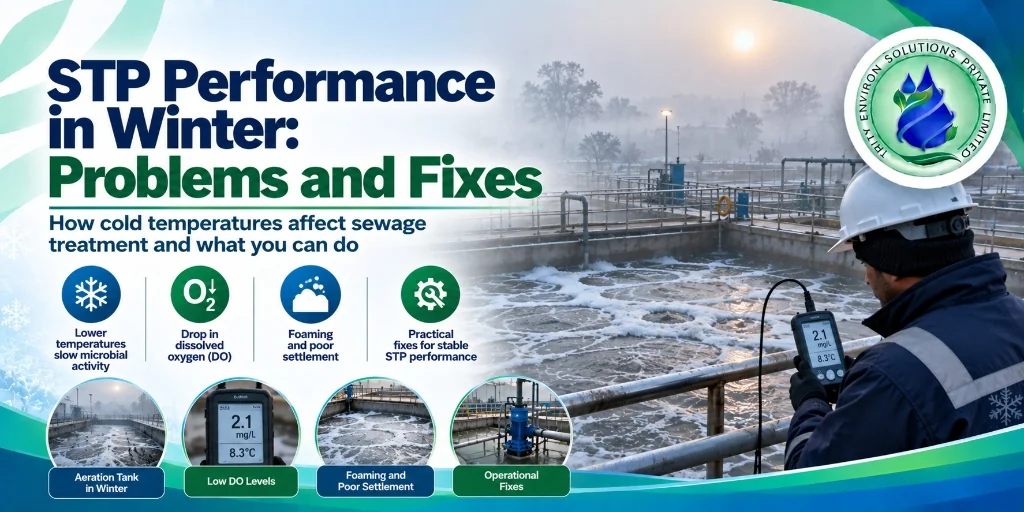
STP Performance in Winter: Problems and Fixes
Trity Enviro explains why STPs struggle in winter: slow nitrification, high ammonia, poor settling and foam. Practical fixes to keep treated water compliant.

 ISO 9001:2015 & QCI Approved
A comprehensive chemical engineering guide on Agitated Thin Film Dryers in ZLD systems, detailing mechanical agitation, heat flux, vacuum drying, and salt cake handling.
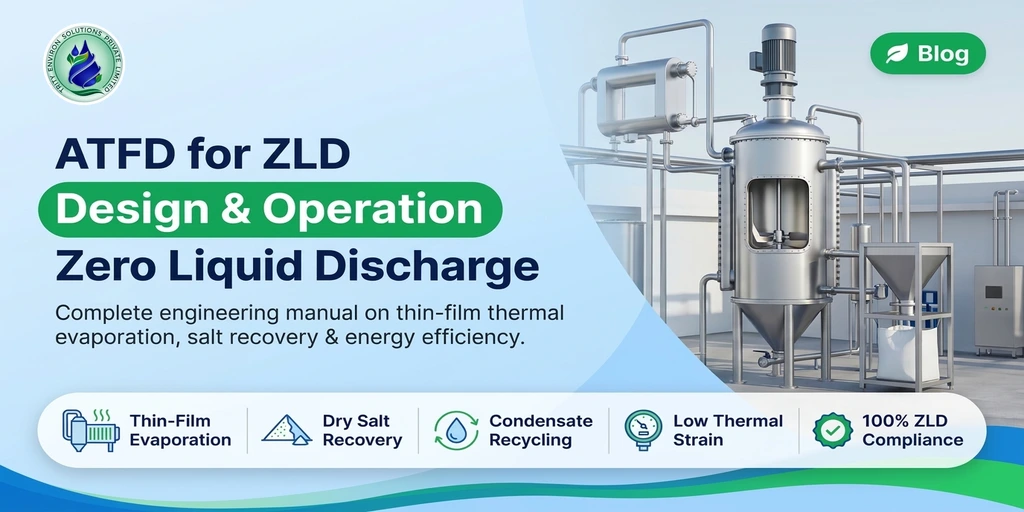
Zero Liquid Discharge (ZLD) has become a regulatory imperative for high-pollution industrial sectors in India, including pharmaceuticals, textiles, distilleries, chemical manufacturing, and electroplating. A typical ZLD train concentrates wastewater through reverse osmosis (RO) and multi-effect evaporators (MEE) or mechanical vapor recompression (MVR). However, evaporators can only concentrate brine up to 35% - 45% total dissolved solids (TDS) before severe salt precipitation blinds heat exchanger tubes.
To complete the ZLD loop, the concentrated slurry must be converted into solid, dry salt cake suitable for secure disposal or resource recovery. Solar evaporation pans are increasingly prohibited by pollution boards due to groundwater seepage and air pollution risks.
The Agitated Thin Film Dryer (ATFD) is the industry-standard technology for terminal thermal drying. By mechanically spreading concentrated slurry into a thin, turbulent film across a steam-heated vertical cylindrical surface, the ATFD achieves instantaneous flash evaporation, converting liquid concentrate into free-flowing, baggable dry salt with single-pass continuous operation.
The ATFD consists of a vertical, steam-jacketed cylindrical shell fitted with an internal, high-speed rotating rotor: * Concentrated slurry enters tangentially at the top of the heated drying zone. * Mechanical rotor blades or hinged wiper blades spread the liquid into a continuous, turbulent thin film (0.5 to 2.0 mm thickness) across the heated inner wall. * High agitation prevents boundary-layer thermal resistance, resulting in exceptional overall heat transfer coefficients ($U = 1,200\text{ to }1,800\text{ W/m}^2\cdot\text{K}$). * As water flashes into vapor, the slurry rapidly transitions through liquid, viscous slurry, pasty/doughy phase, and finally into dry, granular salt powder that falls by gravity to the discharge cone.
ZLD brines contain extreme concentrations of chlorides (NaCl > 15-20%), sulfates (Na2SO4), and heavy metals at temperatures of 100°C to 135°C. Standard stainless steel (SS304/SS316) suffers rapid stress corrosion cracking and pitting. Premium industrial ATFDs utilize high-nickel alloys: * SS316L / Duplex 2205: For moderate chloride concentrations (<30,000 mg/L). * Super Duplex 2507 / Titanium / Inconel 625: For extreme chloride and acidic ZLD streams. * Hard Facing / Stellite Coating: Applied on rotor blade tips to resist severe abrasive wear from crystalline salts.
Proper ATFD operation balances steam pressure, rotor speed, feed concentration, and vacuum level:
| Feature / Metric | Agitated Thin Film Dryer (ATFD) | Solar Evaporation Pan | Crystallizer + Pusher Centrifuge |
|---|---|---|---|
| Space / Land Footprint | Very Compact (Vertical) | Massive (Acres of Land) | Moderate |
| Weather Dependence | Zero (24/7 All-Weather Operation) | Heavy (Fails in Monsoon / Winter) | Zero (All-Weather) |
| Product Salt Moisture | Free-flowing dry powder (< 5% moisture) | Wet slurry (> 20% moisture) | Damp cake (8% - 15% moisture) |
| Groundwater Contamination Risk | Zero (Enclosed steel vessel) | Extreme (Liner tears & seepage) | Zero (Enclosed) |
| Regulatory SPCB Status | Mandated & Approved for ZLD | Banned / Strictly Phased Out | Approved for large single-salt streams |
| Suitability for Mixed Salts | Excellent (Handles sticky mixed salts) | Moderate | Poor (Mixed salts blind basket screens) |
Trity Environ Solutions designs, manufactures, and integrates heavy-duty vertical and horizontal Agitated Thin Film Dryers engineered for demanding Zero Liquid Discharge projects across India.
Speak directly with our senior environmental engineers for technical guidance, sizing calculations, or a tailored project proposal.
Call +91-9821030072 or email enquiry@trityenviro.com
Trity Enviro explains why STPs struggle in winter: slow nitrification, high ammonia, poor settling and foam. Practical fixes to keep treated water compliant.

Explore reverse osmosis (RO) – how it works, benefits for health, taste, and eco-friendliness. Learn about its applications in homes, industries, and more.

Dissolved oxygen in wastewater treatment explained: the ideal 2-3 mg/L range, why treatment plants need less oxygen than rivers, and DO control methods.











Discuss your requirements with our engineering team and get practical guidance for your project.

